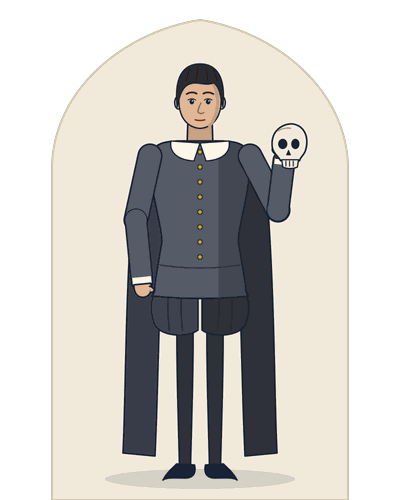
Hamlet
Prince of Denmark, son of the dead King Hamlet and of Gertrude. Commanded to avenge his father, he delays, kills Polonius by mistake, and kills Claudius only as he himself dies.

Hamlet is William Shakespeare’s tragedy of a Danish prince whose father’s Ghost commands him to avenge his murder by Claudius, the new king. This Hamlet study guide gives you the complete play with a plain modern English line under every line, a unit for every scene, and the answers examiners look for.
The book is being prepared for Amazon now. Send one short email and you will hear as soon as it is out.
Email me when it is outThis opens your email app with a short message to qaisar@janjuaslitnotes.com already written: just press Send. Your email address is used only to tell you when this book is out. How your email is used.
Hamlet is a revenge tragedy in five acts: the Ghost of Hamlet’s father reveals that Claudius murdered him, and the Prince’s long, troubled revenge ends in a duel that kills Gertrude, Claudius, Laertes and Hamlet. Here is the whole play act by act, as the book sums it up.
At midnight on the castle walls of Elsinore, the guards show Horatio a Ghost like the dead King Hamlet. Claudius, the dead king’s brother, has taken the crown and married the widow, Gertrude. The Ghost tells Prince Hamlet that Claudius murdered him, and Hamlet swears revenge and plans to act mad.
Polonius decides that love for his daughter Ophelia has driven the Prince mad, and Claudius sends for Rosencrantz and Guildenstern to spy on him. When the Players arrive, Hamlet plans a test: “The play’s the thing / Wherein I’ll catch the conscience of the king” (2.2.580-581).
Hamlet asks “To be, or not to be” (3.1.56) and turns on Ophelia while the King and Polonius watch. The Players act a murder like his father’s, and Claudius stops the play. Hamlet spares the King at prayer, then kills the hidden Polonius in his mother’s closet.
Claudius ships Hamlet to England with letters that order his death. Ophelia goes mad with grief, and Laertes returns to avenge his father. Pirates bring Hamlet back, and Claudius and Laertes plot his death in a fencing match; then Gertrude reports that Ophelia has drowned.
In the graveyard Hamlet holds Yorick’s skull and fights Laertes in Ophelia’s grave. In the fencing match a poisoned sword and a poisoned cup kill Gertrude, Claudius, Laertes and Hamlet, and Fortinbras arrives to claim Denmark.
Shakespeare wrote Hamlet about 1599 to 1601. It was first printed in 1603, in the short First Quarto; the longer Second Quarto followed in 1604, and the First Folio in 1623.
17 units, one for each scene or group of scenes, then the essays and the revision. Every unit follows the same plan, so you always know where to look.
The text is the Cambridge Shakespeare, edited by William George Clark and William Aldis Wright (Macmillan, 1866), with obvious misprints corrected. Every quotation and line number in the book is checked against it, and every quotation carries act, scene and line: 3.1.56 means Act 3, Scene 1, line 56.
Paperback, 6 x 9 in, 558 pages, and a Kindle ebook.
Available on Amazon
Unit 8: To Be, or Not to Be, complete, with the title page, A Note from the Author and the contents.
Every line of the play has a plain modern English line under it, and the hard words are explained after the passage. This is the start of the most famous soliloquy, as the book prints it.
“That is what this book is for. Every line of the play sits beside its meaning in plain modern English, so you always know what is being said.”
Spies, a soliloquy and the nunnery Act 3, Scene 1 · Lines 56 to 60
To be, or not to be: that is the question:
To live, or not to live: that is the question:
Whether 'tis nobler in the mind to suffer
Whether it is nobler in the mind to endure
The slings and arrows of outrageous fortune,
The stones and arrows of cruel fortune,
Or to take arms against a sea of troubles,
Or to take up weapons against an ocean of troubles,
And by opposing end them? To die: to sleep;
And by fighting them, end them? To die: to sleep;
Words58 slings: stones thrown from slings
The book gives one unit to each scene or group of scenes: 17 units in all, from the Ghost on the castle walls to the duel. Each line below is the book’s own summary of the scene.
At midnight on the castle walls, the guards show Horatio a Ghost that looks like the dead king. It will not speak to them, so they decide to tell young Hamlet.
Claudius, now king and married to his brother’s widow, rules the court with smooth words. Hamlet, still in black, wishes he could die, then learns that a ghost in his father’s shape walks at night.
Laertes, about to sail for France, warns Ophelia against Hamlet. Polonius gives his son rules for life, then orders his daughter to stop seeing Hamlet.
At midnight, while the King feasts inside, Hamlet keeps watch with Horatio and Marcellus. The Ghost appears and beckons, and Hamlet follows it against his friends' warnings.
Alone with Hamlet, the Ghost names his murderer and demands revenge. Hamlet vows to remember, swears his friends to silence and plans to seem mad.
Polonius sends Reynaldo to spy on Laertes in Paris. Then a frightened Ophelia describes Hamlet’s wild, silent visit, and Polonius decides that love has driven the Prince mad.
Claudius sets Hamlet’s old friends to spy on him, and Polonius blames love for his madness. Then the Players arrive, and Hamlet plans to test the King with a play.
Claudius and Polonius hide to watch Hamlet meet Ophelia. Hamlet, alone as he believes, weighs life against death, then turns on Ophelia.
Hamlet coaches the Players and asks Horatio to watch the King. The Players act a murder like old Hamlet’s; Claudius rises, the play breaks off, and Hamlet sets off to see his mother.
Claudius orders Hamlet to England, then kneels and tries to pray. Hamlet finds him on his knees, but puts his sword away to wait for a worse revenge.
Hamlet kills Polonius through the arras, then forces his mother to compare her two husbands. The Ghost returns, seen only by Hamlet.
Hamlet hides the body of Polonius and mocks his school friends. Claudius ships him to England with a secret order for his death.
Fortinbras marches to fight for a worthless patch of Poland. Hamlet, bound for England, measures himself against him.
Ophelia, driven mad by grief, sings of death and lost love before the court. Laertes breaks in to avenge his father, and Claudius talks him round.
Hamlet’s letters announce his return to Denmark. Claudius and Laertes plot his death in a fencing match, and Gertrude brings word that Ophelia has drowned.
Two Clowns joke as they dig Ophelia’s grave. Hamlet, back in Denmark, holds Yorick’s skull, then fights Laertes in the open grave.
Hamlet tells Horatio how he sent Rosencrantz and Guildenstern to the death meant for him. He dies in the poisoned duel, but kills Claudius first, and Fortinbras arrives to claim Denmark.
Hamlet turns on a small circle of characters: a prince, his mother, his uncle the King, and the family of Polonius. The book draws fifteen of them in one house style; here they are with the book’s own notes on each.
Prince of Denmark, son of the dead King Hamlet and of Gertrude. Commanded to avenge his father, he delays, kills Polonius by mistake, and kills Claudius only as he himself dies.
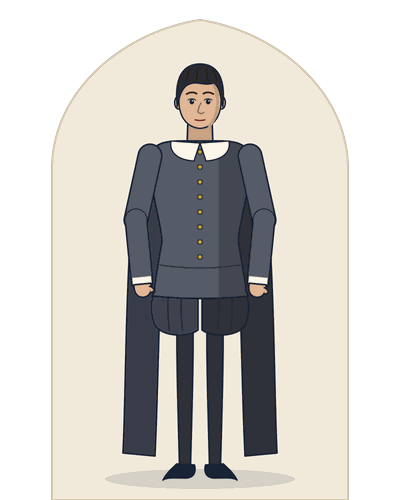
Hamlet in his soliloquies, the speeches he makes alone on stage or unheard by others, where he thinks aloud about grief, revenge and death.
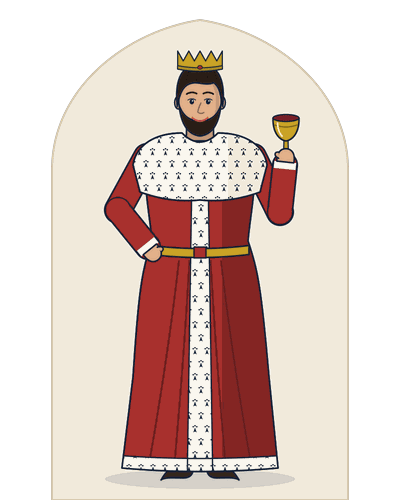
King of Denmark. He poisoned his brother, Hamlet’s father, took the crown and married the widow. Hamlet kills him in the last scene.
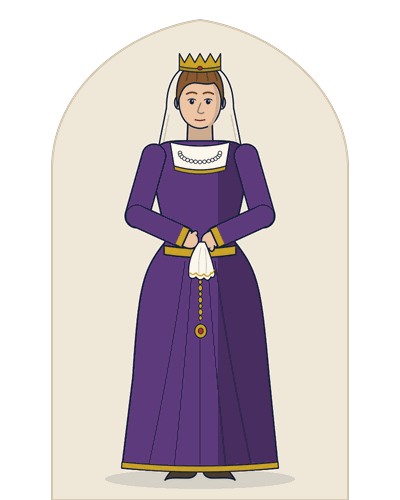
Queen of Denmark and Hamlet’s mother, who married Claudius soon after her husband’s death. She drinks the poisoned cup meant for her son.
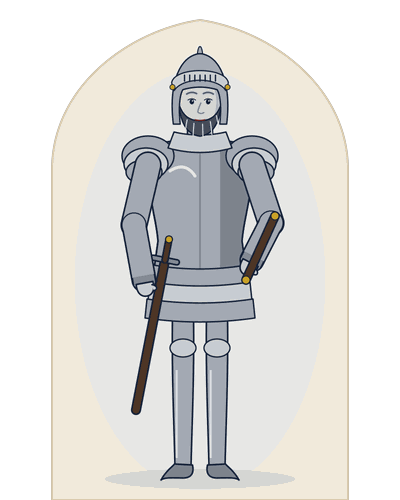
The spirit of Hamlet’s father, the dead King Hamlet. He reveals his murder, commands revenge, and appears for the last time in the closet scene, seen only by Hamlet.
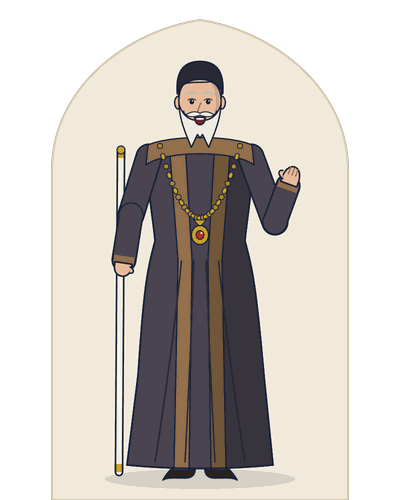
The Lord Chamberlain, father of Laertes and Ophelia: a wordy old man and a busy spy. Hamlet kills him through the arras.
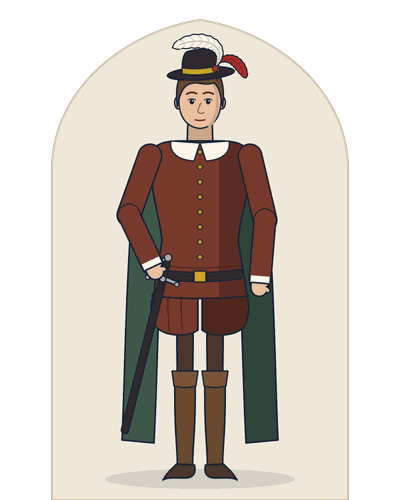
Polonius’s son, who lives in France. He returns to avenge his father, plots with Claudius, and dies by his own poisoned sword, forgiving Hamlet.
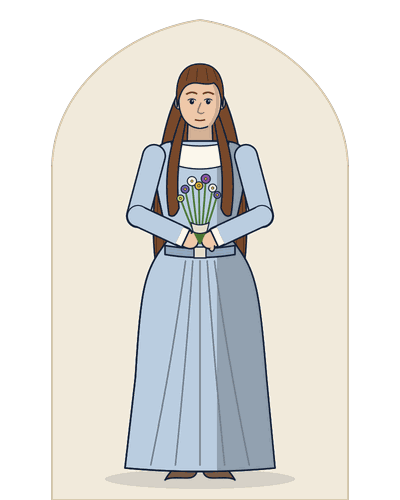
Polonius’s daughter, loved by Hamlet. She obeys her father and rejects Hamlet; after her father’s death she goes mad and drowns.
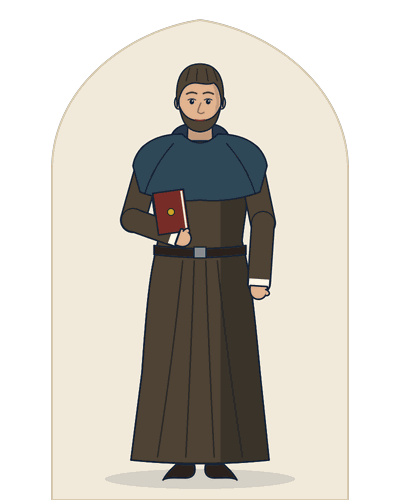
Hamlet’s calm, loyal friend and fellow-student from Wittenberg. He sees the Ghost, watches the King at the play, and lives to tell Hamlet’s story.
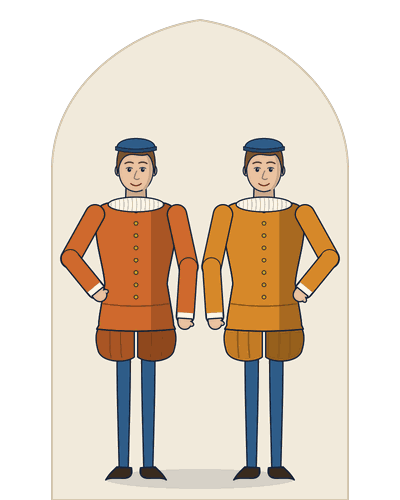
Hamlet’s old school friends, sent for by Claudius to spy on him. On the voyage to England Hamlet forges a new royal letter that sends them to their deaths.
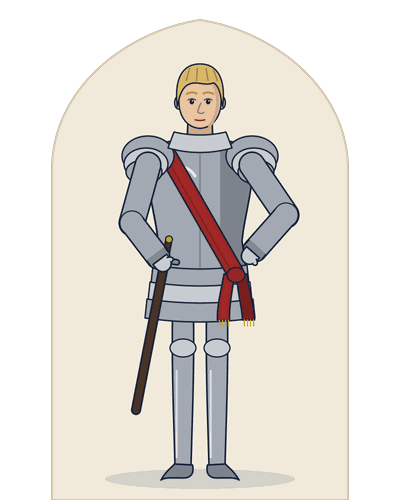
Prince of Norway, whose father was killed by old Hamlet in a duel. At the end Hamlet gives him his “dying voice”, his last vote, for the crown.
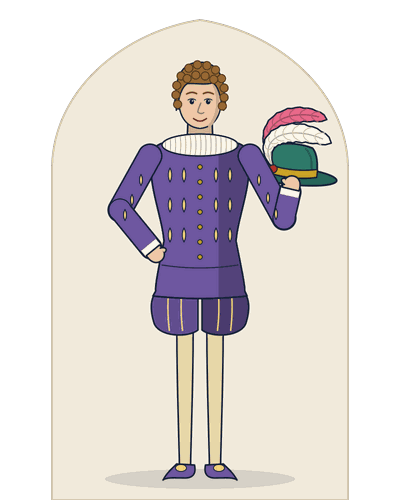
A showy young courtier. He brings the King’s wager to Hamlet and calls the hits in the fencing match.
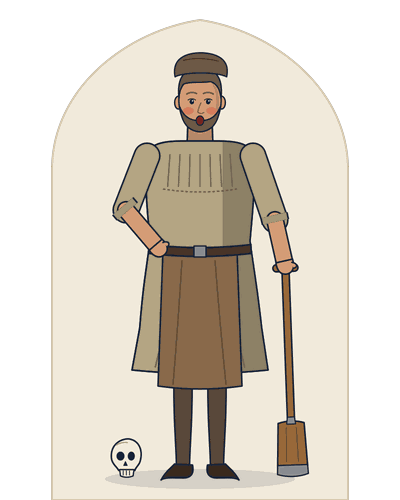
The First Clown in this text: a witty sexton who digs Ophelia’s grave and shows Hamlet the skull of Yorick.
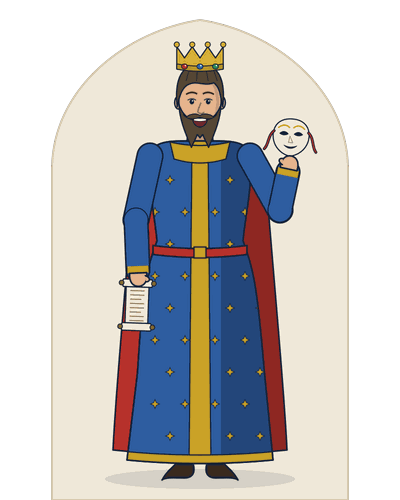
One of the Players who come to Elsinore. Hamlet uses their play, The Mousetrap, to catch the conscience of the King.
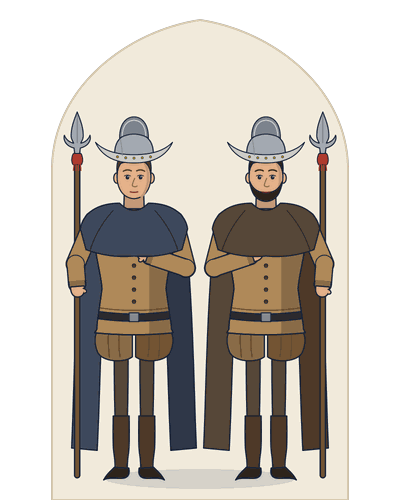
Officers of the watch, who show Horatio the Ghost on the castle walls in the first scene.
These are thirteen of the quotations the book’s scene cards pick out, each with its speaker, its act, scene and line in the Cambridge text, and what it shows. The book’s quotation bank has 48.
| Quotation | Speaker and line | What it shows |
|---|---|---|
| “Frailty, thy name is woman!” | Hamlet1.2.146 | Hamlet’s disgust at his mother’s quick remarriage. |
| “This above all: to thine own self be true” | Polonius1.3.78 | The most famous line of Polonius’s rules for his son. |
| “Something is rotten in the state of Denmark” | Marcellus1.4.90 | As Hamlet follows the Ghost, Marcellus names the sickness of the state. |
| “That one may smile, and smile, and be a villain” | Hamlet1.5.108 | Hamlet learns that a face can lie. |
| “To put an antic disposition on” | Hamlet1.5.172 | Hamlet plans to seem mad. |
| “Though this be madness, yet there is method in’t” | Polonius2.2.203-204 | Polonius sees sense in Hamlet’s wild talk. |
| “The play’s the thing / Wherein I’ll catch the conscience of the king” | Hamlet2.2.580-581 | Hamlet plans his test of the King. |
| “To be, or not to be: that is the question” | Hamlet3.1.56 | Hamlet weighs life against death. |
| “Get thee to a nunnery” | Hamlet3.1.121 | Hamlet turns on Ophelia while her father listens. |
| “O, my offence is rank, it smells to heaven” | Claudius3.3.36 | Claudius admits his crime, though only when alone. |
| “Words without thoughts never to heaven go” | Claudius3.3.98 | The King’s prayer was empty all along. |
| “Alas, poor / Yorick! I knew him, Horatio” | Hamlet5.1.173-174 | Hamlet faces death in the skull of a jester he loved. |
| “the readiness is all” | Hamlet5.2.209 | Hamlet accepts whatever comes. |
The book answers the twelve questions examiners set most often on Hamlet with twelve model essays. Each is written in full for long papers, with a marked cut line where a shorter answer can stop. These are the topics:
Four pages as they appear in the book: the title page, a scene card, a page of text with modern English, and a critical note. Select a page to see it larger.
Short, direct answers taken from the Hamlet study guide itself.
Yes. It prints the complete play from the Cambridge Shakespeare, edited by W. G. Clark and W. A. Wright (1866), in 17 units, one for each scene or group of scenes. Under every line there is a plain modern English line, with notes on hard words after each passage.
Yes. Every line of the play has a plain modern English line beneath it. “To be, or not to be: that is the question” (3.1.56), for example, becomes “To live, or not to live: that is the question”.
The book follows six themes through the play: revenge, seeming (appearance against reality), death, madness, corruption and love. Every point on a scene card carries its theme tag, and each theme leads to the essays that need it; revenge, for example, runs through the essays on the foils, the revenge tragedy and the delay.
The book’s twelve model essays answer the Hamlet questions examiners set most often: Hamlet as a tragic hero, Claudius, the foils, Ophelia, Gertrude, the soliloquies, dramatic craft, revenge tragedy, madness, the play within the play, the delay, and appearance and reality. Each essay is written in full for long papers, with a marked cut line where a shorter answer can stop.
The book’s answer is that the madness is feigned but the melancholy beneath it is real. Hamlet’s “antic disposition” (1.5.172) is chosen, announced and controlled, and it serves his purpose of watching and wounding his enemies; beneath it lies a real melancholy, and at Ophelia’s grave a real passion. He is mad in craft, but heartsick in fact.
Not because he lacks courage, the book argues, but because his courage serves a mind that must know, judge and feel before it acts. The need for proof explains the first delay, conscience the second, and melancholy and too much thought the rest.
Four characters die in the last scene, in this order: Gertrude, Claudius, Laertes and Hamlet. Gertrude drinks the poisoned cup meant for Hamlet, Laertes and Hamlet are both wounded by the poisoned sword, and Hamlet kills Claudius with the sword and the cup. Horatio lives to tell the story, and Fortinbras arrives to claim Denmark.
Not always. The book keeps the line numbers of the Cambridge edition, and other editions number some lines differently, by many lines in the long prose scenes. Examiners name passages by act and scene, so find the scene first, then the words.
The free PDF sample has the title page, A Note from the Author, the contents and the whole of Unit 8: To Be, or Not to Be, as it appears in the book.