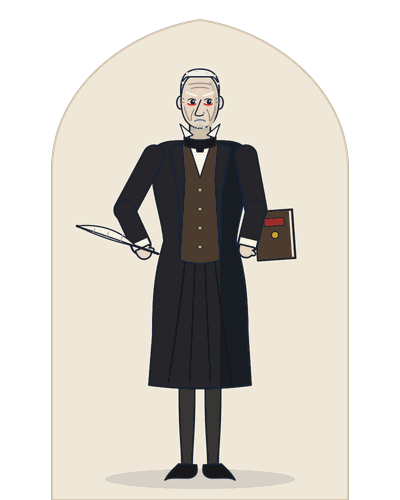
Ebenezer Scrooge
A London man of business, “a squeezing, wrenching, grasping, scraping, clutching, covetous, old sinner!” (1.6). The Spirits change him into “as good a man, as the good old city knew” (5.70).

A Christmas Carol is Charles Dickens’s story of Ebenezer Scrooge, a miser who is visited on Christmas Eve by the Ghost of his dead partner and by three Spirits, and who wakes on Christmas morning a changed man. This A Christmas Carol study guide gives you the whole story, stave by stave, with a plain modern English paragraph after every paragraph of Dickens, two units for each stave, and the answers examiners look for.
The book is being prepared for Amazon now. Send one short email and you will hear as soon as it is out.
Email me when it is outThis opens your email app with a short message to qaisar@janjuaslitnotes.com already written: just press Send. Your email address is used only to tell you when this book is out. How your email is used.
A Christmas Carol is a story in five staves: on Christmas Eve a miser, Scrooge, is warned by the Ghost of his dead partner, is shown his past, his present and what may be by three Spirits, and wakes on Christmas morning to make amends. Here is the whole story stave by stave, as the book sums it up.
On Christmas Eve Scrooge, a miser, sits in his counting-house, seven years after his partner Marley died (1.46). His nephew wishes him “A merry Christmas, uncle!” (1.12), and Scrooge answers “Humbug!” (1.13). He refuses two gentlemen collecting for the poor: those who would rather die had better do it and “decrease the surplus population.” (1.62). He grudges his clerk a holiday on Christmas Day (1.71 to 1.75). At home he sees Marley’s face in the door knocker (1.81). Marley’s Ghost comes through the locked door, dragging a chain of cash-boxes (1.97). It tells him “Mankind was my business.” (1.148). It promises “Three Spirits.” (1.158), the first “when the bell tolls One.” (1.163).
At one o’clock the curtains of Scrooge’s bed are drawn aside (2.18 to 2.19). The Ghost of Christmas Past is “like a child: yet not so like a child as like an old man” (2.20). It shows Scrooge “Your past.” (2.28). He weeps for the lonely boy he was at school (2.54). His little sister Fan comes to take the boy home (2.67 to 2.70). Old Fezziwig, the master of his youth, gives a Christmas Eve ball (2.93). Then Belle, the girl he was to marry, releases him: “Another idol has displaced me” (2.112). He sees her happy family years later (2.136). At last he presses the Ghost’s cap down over its light (2.149), and sleeps.
The Ghost of Christmas Present is “a jolly Giant, glorious to see” (3.5). It leads Scrooge through the Christmas streets to the house of his clerk, Bob Cratchit (3.41). The family enjoy their goose and pudding, and Tiny Tim says “God bless us every one!” (3.68). The Ghost warns that, if nothing changes, “the child will die.” (3.71). Then it repeats Scrooge’s own words about the “surplus population.” (3.73). They visit miners (3.90), a lighthouse (3.93) and a ship (3.95). At the party of Scrooge’s nephew, Fred, the guests drink to “Uncle Scrooge!” (3.127). As its life ends, the Ghost shows two wretched children: “This boy is Ignorance. This girl is Want.” (3.144). Then “a solemn Phantom, draped and hooded” (3.148) comes towards Scrooge.
The Ghost of Christmas Yet To Come “neither spoke nor moved.” (4.3). It shows Scrooge what may be. Rich men joke that a dead man will have “a very cheap funeral” (4.24). In old Joe’s shop a charwoman, a laundress and an undertaker’s man sell the dead man’s things (4.44). His body lies alone in the dark, and Scrooge cannot uncover the face (4.80). A young couple who owed him money are glad: “it was a happier house for this man’s death!” (4.103). The Cratchits mourn Tiny Tim, and Bob cries “My little, little child!” (4.122). In a churchyard Scrooge reads on a grave “his own name, EBENEZER SCROOGE.” (4.155). He promises: “I will honour Christmas in my heart, and try to keep it all the year.” (4.164).
Scrooge wakes in his own bed, with time “to make amends in!” (5.1). A boy in the street tells him that it is Christmas Day (5.16). Scrooge decides that “The Spirits have done it all in one night.” (5.17). He sends the prize Turkey to Bob Cratchit in secret: “He sha’n’t know who sends it.” (5.29). He promises the portly gentleman a large gift for the poor, with “A great many back-payments” (5.42). He dines with his nephew: “Will you let me in, Fred?” (5.58). Next morning he catches Bob coming late, and says “I am about to raise your salary!” (5.67). The narrator tells us that Tiny Tim “did NOT die” (5.70). The story ends with Tiny Tim’s words: “God bless Us, Every One!” (5.71).
Dickens wrote A Christmas Carol in the autumn of 1843, in about six weeks. Chapman and Hall published it on 19 December 1843, at five shillings, and the first printing of 6,000 copies had sold out by Christmas Eve. The story has five staves and 709 numbered paragraphs.
10 units, two for each stave, then the essays and the revision. Every unit follows the same plan, so you always know where to look.
The text is that of the first edition (Chapman and Hall, London, 1843), with obvious misprints corrected. Every quotation and paragraph number in the book is checked against it. The book numbers every paragraph of the story, 709 in all, and every quotation carries stave and paragraph: 1.6 means Stave One, paragraph 6.
Paperback, 6 x 9 in, 359 pages, and a Kindle ebook.
Available on Amazon
Stave One (Units 1 and 2), complete, with the title page, the copyright page, a page on how to read the sample and the keys to the objective questions.
Every paragraph of Dickens has a plain modern English paragraph after it, and the hard words are explained after the passage. This is Scrooge’s answer to his nephew’s Christmas greeting, as the book prints it.
“If you have opened this book, you probably have an exam coming, and a short novel that schools everywhere set. A Christmas Carol is the story of one man’s change: a cold old miser, four ghosts, and a Christmas that teaches him to care. It is short, five staves in all, it is full of famous lines, and its questions about money, poverty and kindness are still argued today. None of it needs to frighten you. You need to know what is happening, why the characters act as they do, and how to write about it well.”
Scrooge answers his nephew Stave One · Paragraphs 13 to 16
“Bah!” said Scrooge, “Humbug!”
“Bah!” said Scrooge. “A fraud!”
He had so heated himself with rapid walking in the fog and frost, this nephew of Scrooge’s, that he was all in a glow; his face was ruddy and handsome; his eyes sparkled, and his breath smoked again.
This nephew of Scrooge’s had so warmed himself by walking fast through the fog and frost that he was all aglow. His face was red and handsome, his eyes sparkled, and his breath steamed again.
“Christmas a humbug, uncle!” said Scrooge’s nephew. “You don’t mean that, I am sure?”
“Christmas a fraud, uncle!” said Scrooge’s nephew. “You do not mean that, I am sure?”
“I do,” said Scrooge. “Merry Christmas! What right have you to be merry? What reason have you to be merry? You’re poor enough.”
“I do,” said Scrooge. “Merry Christmas! What right have you to be merry? What reason have you to be merry? You are poor enough.”
Words13 Humbug: a fraud; nonsense meant to deceive
The book gives two units to each stave: 10 units in all, from Scrooge in his counting-house to Scrooge changed. Each line below is the book’s own summary of the unit.
On Christmas Eve, Scrooge turns away his nephew, refuses the two gentlemen collecting for the poor, and grumbles at his clerk’s holiday.
Scrooge sees Marley’s face in the knocker. Then Marley’s Ghost, dragging a chain of cash-boxes, warns him that three Spirits will come.
The first Spirit takes Scrooge back to his childhood. He weeps for his lonely self at school, then meets his little sister.
The Ghost shows Scrooge his old master’s Christmas ball. Then the girl he loved sets him free because he loves money more.
The second Spirit takes Scrooge to Bob Cratchit’s poor home. The family enjoy their dinner; Scrooge asks if Tiny Tim will live.
The Ghost shows Scrooge miners, lighthouse keepers and sailors keeping Christmas, then his nephew’s merry party, and at last two starving children.
A silent Phantom shows Scrooge what is to come. Rich men joke about a man’s death, thieves sell his things, and his body lies alone.
Scrooge sees a family in debt relieved by the man’s death, the Cratchits mourning Tiny Tim, and at last his own grave.
Scrooge wakes in his own bed with time to make amends. He laughs and cries at once, learns it is Christmas Day, and sends the prize Turkey to Bob Cratchit.
Scrooge walks out in his best clothes, promises a large gift to the poor, dines at Fred’s, and next morning raises Bob Cratchit’s salary.
A Christmas Carol turns on one man and the Ghosts who visit him, with the Cratchits, Fezziwig and Ignorance and Want to show him what he has missed. The book has ten drawings in one house style; here they are with the book’s own notes on each.
A London man of business, “a squeezing, wrenching, grasping, scraping, clutching, covetous, old sinner!” (1.6). The Spirits change him into “as good a man, as the good old city knew” (5.70).
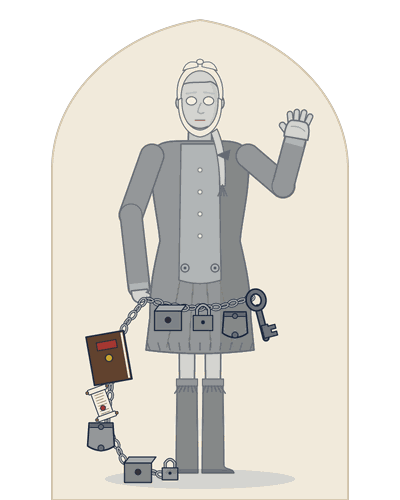
Scrooge’s partner, dead “these seven years” (1.46). His Ghost wears a chain of cash-boxes and warns Scrooge that three Spirits will come.
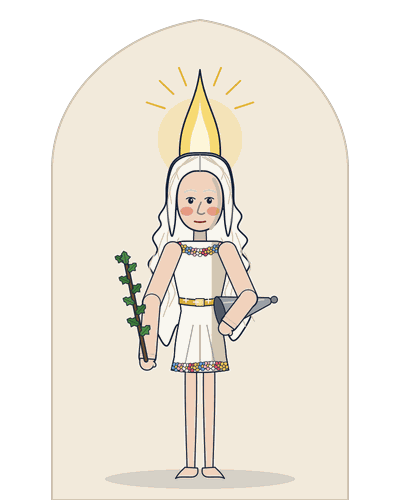
The first Spirit, with “a bright clear jet of light” (2.20) springing from its head. It shows Scrooge his boyhood, Fezziwig and Belle.
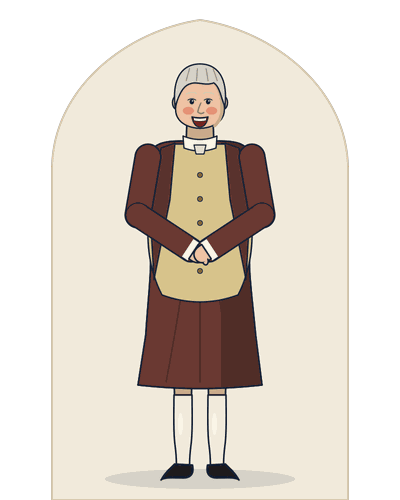
Scrooge’s old master, “an old gentleman in a Welsh wig” (2.83). He gives his apprentices and workers a Christmas Eve ball.
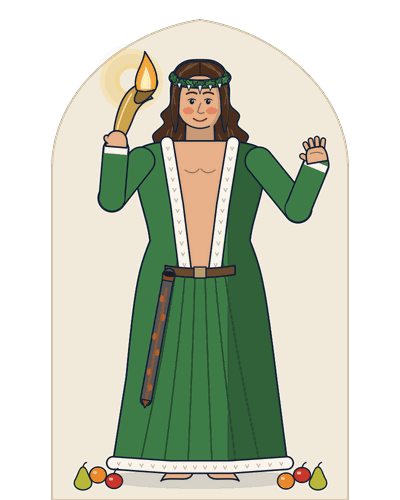
The second Spirit, a giant who carries “a glowing torch” (3.5). It shows Scrooge the Cratchits, Fred’s party, and Ignorance and Want.
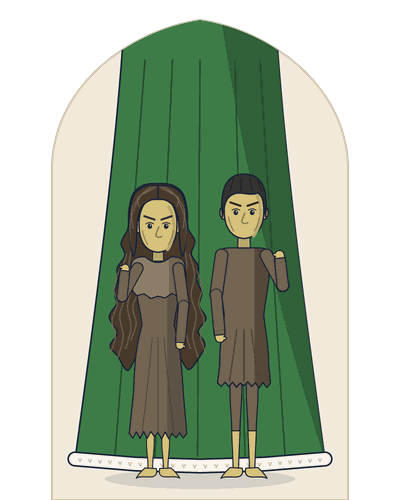
Two wretched children who come from the robe of the Ghost of Christmas Present: “They are Man’s” (3.144).
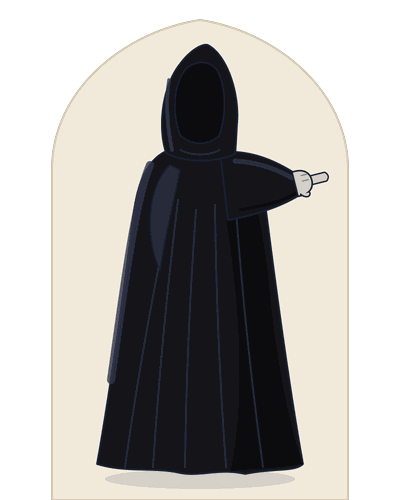
The last Spirit, a silent Phantom “shrouded in a deep black garment” (4.2). It points to a lonely death and a neglected grave.
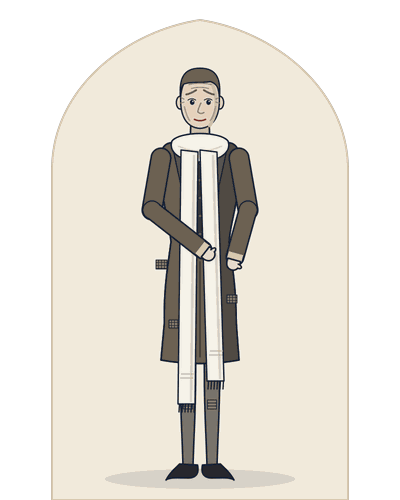
Scrooge’s clerk, on “fifteen shillings a week” (1.43); the text first names him in Stave Three (3.41). He is gentle, loyal and a loving father.
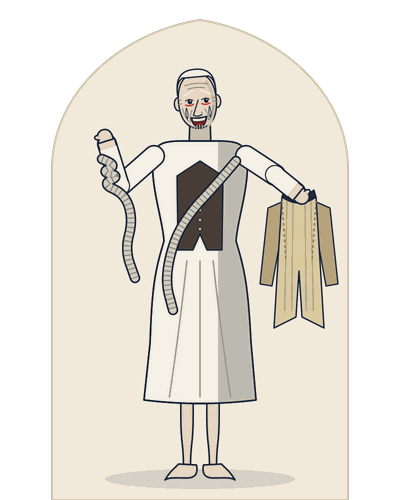
Scrooge wakes in his own bed with time to make amends. He laughs and cries at once, learns it is Christmas Day, and sends the prize Turkey to Bob Cratchit.
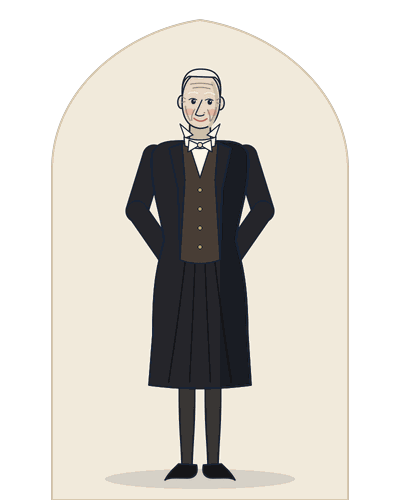
Scrooge walks out in his best clothes, promises a large gift to the poor, dines at Fred’s, and next morning raises Bob Cratchit’s salary.
These are thirteen of the forty key passages in the book’s passage bank, each with its speaker, its stave and paragraph, and the first thing the book says about why it matters.
| Passage | Speaker and paragraph | Why it matters |
|---|---|---|
| “MARLEY was dead: to begin with.” | The narrator1.1 | The first sentence; the death must be certain, or the Ghost would be no wonder. |
| “a squeezing, wrenching, grasping, scraping, clutching, covetous, old sinner!” | The narrator1.6 | The first portrait of the miser: six words of greed in one breath. |
| “‘Bah!’ said Scrooge, ‘Humbug!’” | Scrooge1.13 | His answer to Christmas, and to every kind feeling, in two words. |
| “they had better do it, and decrease the surplus population.” | Scrooge1.62 | His cruellest words on the poor; the Ghost of Christmas Present throws them back (3.73). |
| “I wear the chain I forged in life” | Marley’s Ghost1.131 | The chain of cash-boxes is self-made; Scrooge is making a longer one. |
| “Mankind was my business.” | Marley’s Ghost1.148 | The moral of the story in four words: people come before trade. |
| “Another idol has displaced me” | Belle2.112 | The idol is “A golden one.” (2.114): he chose gain before love. |
| “‘God bless us every one!’ said Tiny Tim, the last of all.” | Tiny Tim3.68 | The weakest child blesses everyone; the narrator ends the novel with his words (5.71). |
| “This boy is Ignorance. This girl is Want.” | The Ghost of Christmas Present3.144 | Allegory, a story whose characters and events stand for ideas; the boy is the greater danger. |
| “I fear you more than any spectre I have seen.” | Scrooge4.10 | He fears the silent Spirit most, yet already hopes “to live to be another man” (4.10). |
| “I will honour Christmas in my heart, and try to keep it all the year.” | Scrooge4.164 | The turning point: the promise that Stave Five keeps. |
| “the Time before him was his own, to make amends in!” | The narrator5.1 | The gift of the Spirits is time; to make amends is to put right a wrong. |
| “He became as good a friend, as good a master, and as good a man, as the good old city knew” | The narrator5.70 | The change lasts; Tiny Tim lives and Scrooge is “a second father” (5.70). |
The book answers the twelve questions examiners set most often on A Christmas Carol with twelve model essays. Each is written in full for long papers, with a marked cut line where a shorter answer can stop. These are the topics:
Four pages as they appear in the book: the title page, a unit card, a page of text with modern English, and a critical note. Select a page to see it larger.
Short, direct answers taken from the A Christmas Carol study guide itself.
Yes. It prints the whole story, all five staves, from the first edition (Chapman and Hall, London, 1843), in 10 units, two for each stave. Every one of the 709 numbered paragraphs has a plain modern English paragraph after it, and 517 hard words and phrases are explained in word notes after the passages.
Yes. Every paragraph of Dickens is followed by its meaning in plain modern English: a short paragraph has its modern English directly beneath it, and a long one is followed by its modern English as one paragraph. “Bah!” said Scrooge, “Humbug!” (1.13), for example, becomes “Bah!” said Scrooge. “A fraud!”
The book follows six themes through the story: money (money and greed), change (Scrooge’s change and the power of memory), poverty (poverty, the poor and their children), family (family and home), Christmas (Christmas and the Christmas spirit) and ghosts (the four Ghosts and their warnings). Every point on a unit card carries its theme tag, and each tag leads to the essays that need it; poverty, for example, leads to Essay 3, on Dickens’s social message, and Essay 9, on the children in the story.
The book’s twelve model essays answer the A Christmas Carol questions examiners set most often: Scrooge’s character and change, the four Ghosts, poverty and the poor, Christmas, family, Marley’s Ghost and the chain, the structure of the five staves, the narrator’s voice and humour, Tiny Tim, Ignorance and Want, money and greed, memory and time, and symbols and imagery. The book marks four of them “Frequently set”: Scrooge’s character and change, the four Ghosts, poverty and the poor, and family. Each essay is written in full for long papers, with a marked cut line where a shorter answer can stop.
Four Ghosts visit Scrooge. The first is Marley’s Ghost, in Stave One. The other three are the Spirits: the Ghost of Christmas Past in Stave Two, the Ghost of Christmas Present in Stave Three and the Ghost of Christmas Yet To Come in Stave Four. So Marley’s Ghost is a Ghost, but he is not one of the three Spirits.
Because Dickens calls the book a carol, and a stave is a verse of a song. The five staves are Marley’s Ghost, The First of the Three Spirits, The Second of the Three Spirits, The Last of the Spirits and The End of It. This book gives each stave two units, and numbers every paragraph of the story, so a reference such as (1.6) means Stave One, paragraph 6.
The text does not settle it. Marley’s Ghost promises one Spirit a night, on three nights (1.163 to 1.165), but in Stave Five Scrooge says “The Spirits have done it all in one night.” (5.17).
Not always. The book numbers every paragraph of the 1843 text, and every speech counts as one paragraph, however short, so the numbers will not match the pages of your own copy. Find the number in the margin of the book’s text. Examiners name passages by stave and by their sense, so know each passage by what it says as well as by its number.
The free PDF sample has the title page, the copyright page, a page on how to read the sample and the whole of Stave One (Units 1 and 2), as it appears in the book.