
General Prologue study guide: The General Prologue to The Canterbury Tales
The General Prologue is the opening of Geoffrey Chaucer’s Canterbury Tales: in spring, a company of pilgrims meets at the Tabard Inn in Southwark on the road to Canterbury, and the narrator describes each of them in turn. This General Prologue study guide gives you the complete text with a plain modern English line under every line, a unit for every pilgrim, and the answers examiners look for.
Tell me when it is out
The book is being prepared for Amazon now. Send one short email and you will hear as soon as it is out.
Email me when it is outThis opens your email app with a short message to qaisar@janjuaslitnotes.com already written: just press Send. Your email address is used only to tell you when this book is out. How your email is used.
What happens in the General Prologue?
The General Prologue sets up The Canterbury Tales in five movements: a spring opening, a meeting at an inn, the portraits of the pilgrims, the narrator’s apology and the Host’s plan for a storytelling contest. Here is the General Prologue summary the book gives on one page.
The spring Lines 1 to 18
One long sentence. April rain soaks the dry earth, the west wind wakes the shoots and the birds sing, and the same force stirs people to go on pilgrimage, above all to the shrine of Saint Thomas Becket at Canterbury.
The inn Lines 19 to 42
The narrator is lodging at the Tabard in Southwark when twenty-nine pilgrims arrive, strangers thrown together by chance. He joins them and promises to describe each one: who they are, their rank and their dress.
The portraits Lines 43 to 714
One by one, from the Knight to the Pardoner. The narrator praises nearly everyone; the reader sees what the praise leaves out, and the gap between the two is Chaucer’s irony.
The apology Lines 715 to 746
The narrator begs pardon for repeating coarse words and for not setting the pilgrims in order of rank. Both excuses give the poet freedom while he pretends to be modest.
The plan Lines 747 to 858
The Host of the inn proposes a game that becomes the frame of the whole work: each pilgrim will tell two tales on the way to Canterbury and two on the way back, and the best teller wins a free supper. Next morning they draw lots, and the first tale falls to the Knight.
Chaucer lived about 1343 to 1400, and the Prologue is usually dated to the late 1380s. Thomas Becket, whose shrine the pilgrims seek, was murdered in 1170.
What is inside this General Prologue study guide?
24 units, one for each pilgrim or section of the poem, then the essays and the revision. Every unit follows the same plan, so you always know where to look.
In every unit
- A character card: the pilgrim at a glance, with the questions examiners ask
- A background box with the context you need
- The text: every line of the original with a plain modern English line beneath, and word notes
- A critical note: a model answer of about 300 words
- Three short answers and a model context answer
- Five objective questions
In the rest of the book
- Questions That Come: a map of every kind of question, sending you straight to the answer
- The Prologue at a Glance: the whole poem on one page, the pilgrims and the settled facts
- How Answers Are Marked
- Twelve model essays on the questions examiners set most often, each in full with a marked cut line for shorter papers
- Practice and Revise: sixty more objective questions, forty one-line facts, a bank of 40 quotations and a last-night checklist
- Further Reading, and the keys to every objective question
The text
The Middle English text is Walter W. Skeat’s edition, from The Complete Works of Geoffrey Chaucer (Clarendon Press, Oxford, 1900), with obvious misprints corrected. Every quotation and line number in the book is checked against it.
Formats
Paperback, 6 x 9 in, 351 pages, and a Kindle ebook.
Available on Amazon
Free sample
Unit 15: The Wife of Bath, complete, with the title page, A Note from the Author and the contents.
The Canterbury Tales General Prologue in modern English, line by line
Every line of Chaucer’s Middle English has a plain modern English line under it, and the hard words are explained beneath the passage. This is how the poem opens in the book.
“Chaucer wrote the General Prologue more than six hundred years ago, and at first his English can look like another language. It is not. Once you see what each line means, it becomes one of the liveliest things you will ever study.”
The spring opening Lines 1 to 4
Whan that Aprille with his shoures sote
When April with its sweet showers
The droghte of Marche hath perced to the rote,
Has pierced the dryness of March to the root,
And bathed every veyne in swich licour,
And bathed every vein (of every plant) in such moisture
Of which vertu engendred is the flour;
That by its power the flower is brought to life;
Words1 Whan that: when · 1 shoures sote: sweet showers · 2 droghte: drought, dryness · 2 rote: root · 3 swich licour: such moisture · 4 Of which vertu: by whose power · 4 engendred: brought to life · 4 flour: flower
Who are the pilgrims? Chaucer’s character sketches, unit by unit
The book gives one unit to each pilgrim or section of the poem: 24 units in all, from the spring opening to the Host’s plan. Each line below is the book’s own one-line sketch of the pilgrim, with one key quotation and its line number.
Unit 1: The Opening Lines 1 to 42
The season, the shrine, the inn and the narrator
Spring sets the whole company in motion, and a narrator who sees only the surface promises to describe them all.
Nature drives the journey: “Than longen folk to goon on pilgrimages” (12).
Unit 2: The Knight Lines 43 to 78
The ideal of the fighting estate
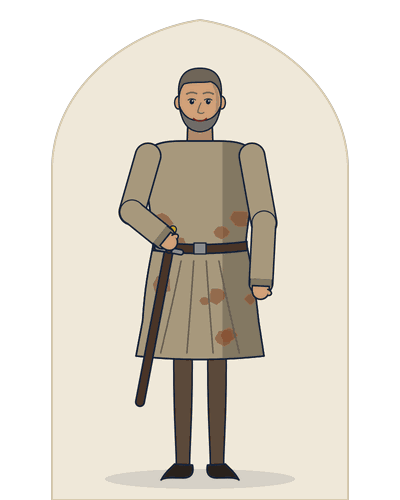
A veteran of every frontier of Christendom who is brave without pride and rides straight from war to pilgrimage.
He loves the code of chivalry: “Trouthe and honour, fredom and curteisye” (46).
Unit 3: The Squire Lines 79 to 100
The Knight’s son, a knight in training and a lover
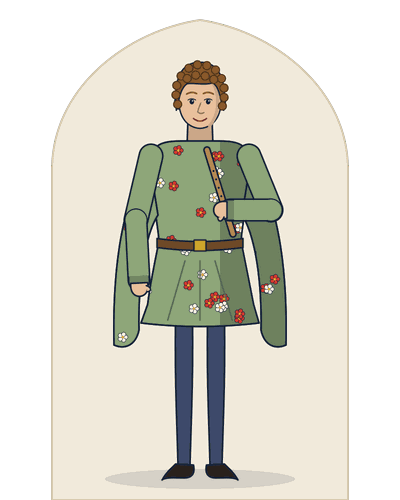
A young lover in flowered clothes who sings all day, yet still carves his father’s meat at table.
Lover and knight in training at once: “A lovyere, and a lusty bacheler” (80).
Unit 4: The Yeoman Lines 101 to 117
The Knight’s servant, a forester
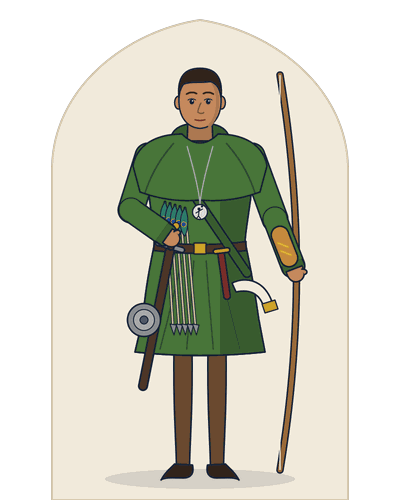
A sunburnt forester in green, armed and neat in every detail, who serves the Knight and never speaks.
The Knight rides plainly: “A YEMAN hadde he, and servaunts namo” (101).
Unit 5: The Prioress and her company Lines 118 to 164
Head of a house of nuns, with a second nun and three priests
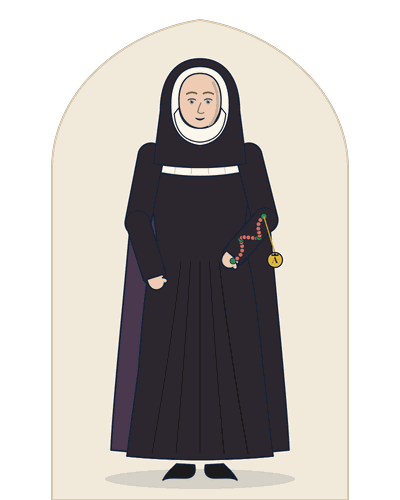
A nun who lives by court manners: refined, tender-hearted and charming, but more a lady of romance than a woman of prayer.
Her pity goes to animals: “She wolde wepe, if that she sawe a mous” (144).
Unit 6: The Monk Lines 165 to 207
A worldly monk of the praying estate
A rich, hunting monk who scorns his Rule, dresses like a lord and wins the narrator’s warm approval.
His office takes him out of the cloister, and he uses it to hunt: “An out-rydere, that lovede venerye” (166).
Unit 7: The Friar Lines 208 to 269
A begging friar who trades in forgiveness
Huberd, a charming licensed beggar, sells easy penance, courts the rich, shuns the poor and makes poverty pay.
Forgiveness for a fee: “He was an esy man to yeve penaunce” (223).
Unit 8: The Merchant Lines 270 to 284
A rich trader of the rising middle class
A dignified trader who talks only of profit, may be hiding debts, and leaves the narrator not even knowing his name.
Dignity may hide debt: “Ther wiste no wight that he was in dette” (280).
Unit 9: The Clerk Lines 285 to 308
A poor Oxford scholar, the ideal of learning
A thin, threadbare Oxford student who spends everything on books and lives to learn and to teach.
Books before comfort: “Twenty bokes, clad in blak or reed” (294).
Unit 10: The Sergeant of the Law Lines 309 to 330
A senior lawyer and judge, rich in fees and land
A brilliant, wealthy lawyer who knows every case and statute, buys up land, and seems even busier than he is.
The image outruns the man: “And yet he semed bisier than he was” (322).
Unit 11: The Franklin Lines 331 to 360
A rich free landowner and county officer
A white-bearded country gentleman who lives for good food and open house, yet serves his county as justice, member of Parliament and sheriff.
Wealth poured out as hospitality: “It snewed in his hous of mete and drinke” (345).
Unit 12: The Guildsmen and the Cook Lines 361 to 387
Five town tradesmen in one livery and the cook they hire
Prosperous craftsmen dressed for civic office, wives who want titles, and a skilled cook with an open sore on his shin.
Each man aims at civic office: “Was shaply for to been an alderman” (372).
Unit 13: The Shipman Lines 388 to 410
A sea captain from the west of England
A sunburnt sea captain who steals wine and drowns his prisoners, yet knows tides and harbours better than any man afloat.
Praise that hides a rogue: “And, certeinly, he was a good felawe” (395).
Unit 14: The Doctor of Physic Lines 411 to 444
A learned physician of the professional middle class
A master of medicine and the stars who has read every authority except the Bible and loves gold most of all.
The closing joke: “Therfore he lovede gold in special” (444).
Unit 15: The Wife of Bath Lines 445 to 476
A wealthy cloth-maker, five times married
A bold, deaf, gap-toothed cloth-maker from near Bath, five times wed, who has seen many great shrines and loves company.
Marriage as a career: “Housbondes at chirche-dore she hadde fyve” (460).
Unit 16: The Parson Lines 477 to 528
The ideal parish priest
A poor village priest, rich only in holiness, who lives the gospel first and preaches it afterwards.
Deeds come before words: “That first he wroghte, and afterward he taughte” (497).
Unit 17: The Ploughman Lines 529 to 541
The ideal of the working estate
The Parson’s brother, a labourer who carts dung, loves God and neighbour, and works for the poor without pay.
He keeps both great commandments: “God loved he best with al his hole herte” (533).
Unit 18: The Miller Lines 542 to 566
A village miller, grinder of corn
A huge red-bearded wrestler and loudmouth who steals corn, tells dirty stories and pipes the pilgrims out of town.
Honest only as millers go: “And yet he hadde a thombe of gold, pardee” (563).
Unit 19: The Manciple Lines 567 to 586
Buyer of food for an Inn of Court
An unlearned servant who buys so shrewdly for more than thirty lawyers that he outwits every one of them.
The servant beats his masters: “And yit this maunciple sette hir aller cappe” (586).
Unit 20: The Reeve Lines 587 to 622
Manager of a lord’s estate
A thin, bad-tempered farm manager whose accounts no one can fault and whose secret wealth grows faster than his lord’s.
The servant outdoes the master: “He coude bettre than his lord purchace” (608).
Unit 21: The Summoner Lines 623 to 668
Lay officer of the Church courts
A pimpled, lustful officer of the archdeacon’s court who sells the Church’s punishments for wine and money.
Punishment for sale: “Purs is the erchedeknes helle” (658).
Unit 22: The Pardoner Lines 669 to 714
A seller of pardons from Rouncival
A seller of pardons with fake relics, a goat’s voice and a fine church manner, who turns forgiveness into profit.
His holy relics are frauds: “And in a glas he hadde pigges bones” (700).
Unit 23: The Narrator’s Apology Lines 715 to 746
The narrator closes the portraits and defends his method
Posing as a plain reporter with a short wit, the narrator claims the freedom to repeat every pilgrim’s words.
A reporter must repeat “Everich a word, if it be in his charge” (733).
Unit 24: The Host and the Plan Lines 747 to 858
The innkeeper of the Tabard, guide and judge of the game
A large, merry innkeeper turns a pilgrimage into a storytelling contest and makes himself its judge.
The prize: “Shal have a soper at our aller cost” (799).
Every pilgrim, drawn for the book
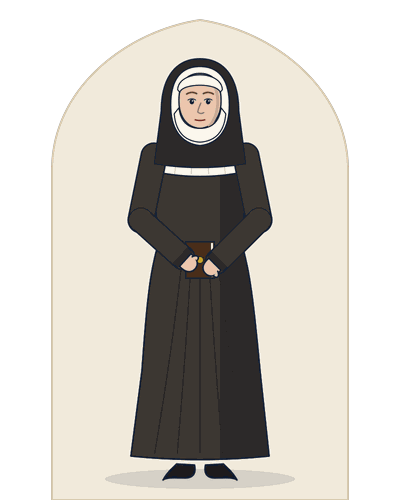
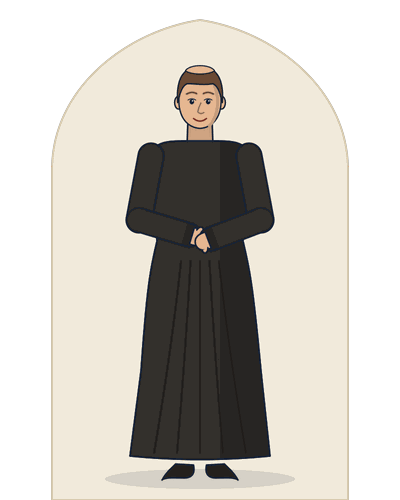
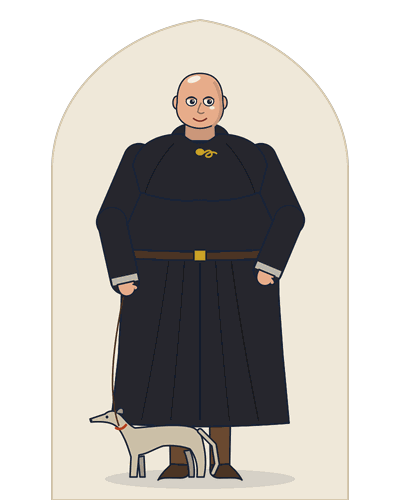
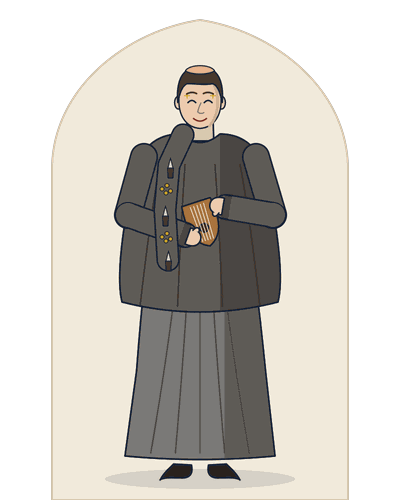
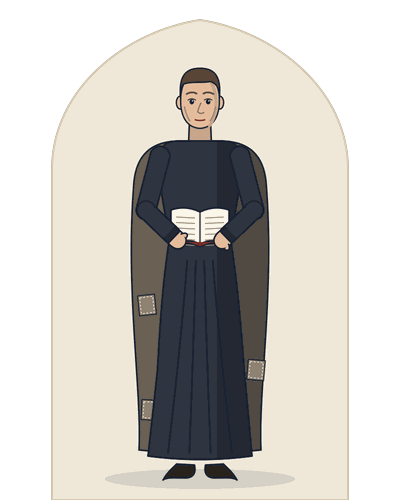
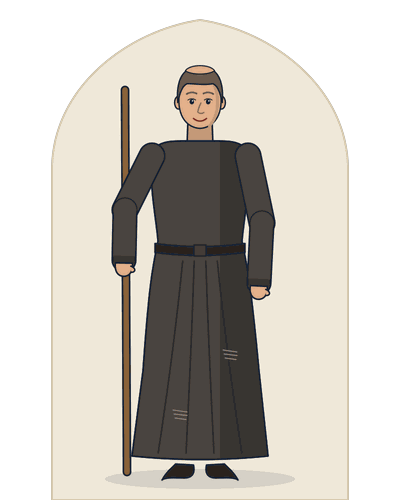
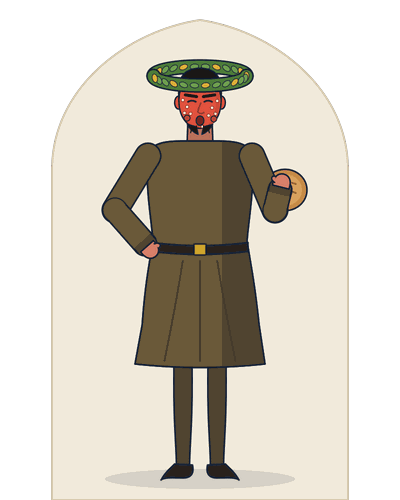
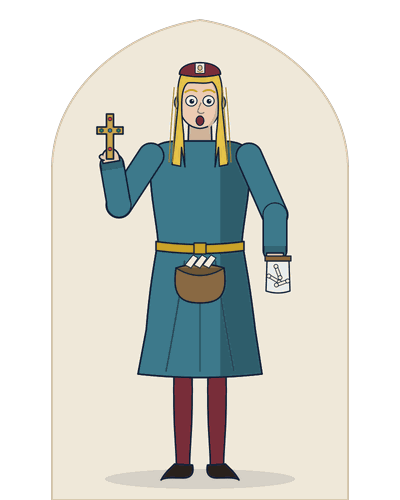
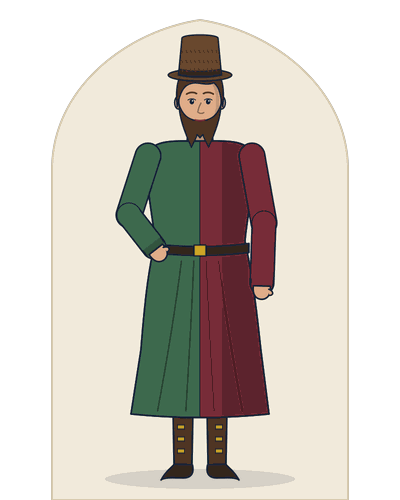
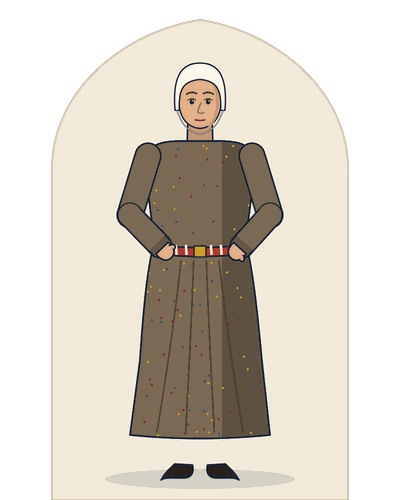
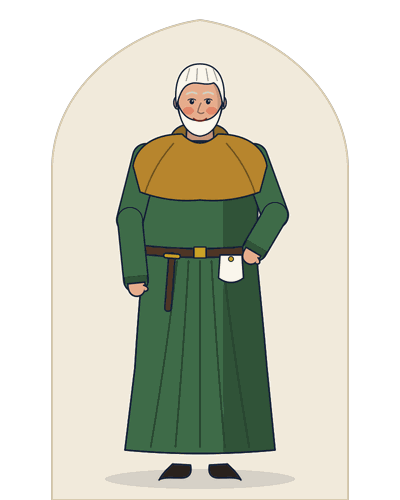
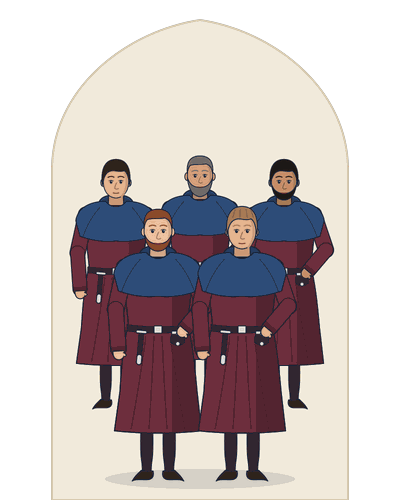
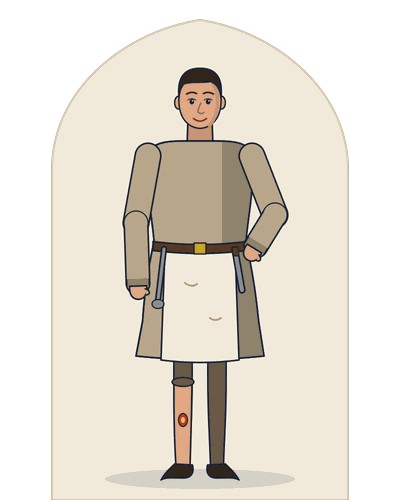
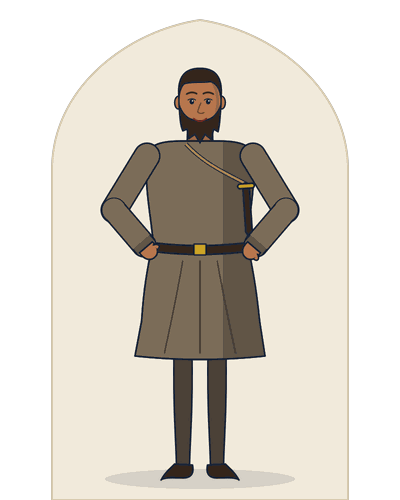
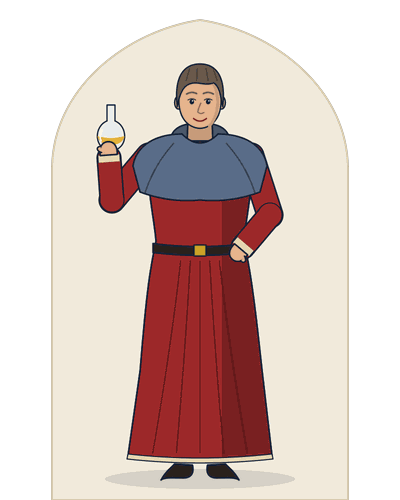
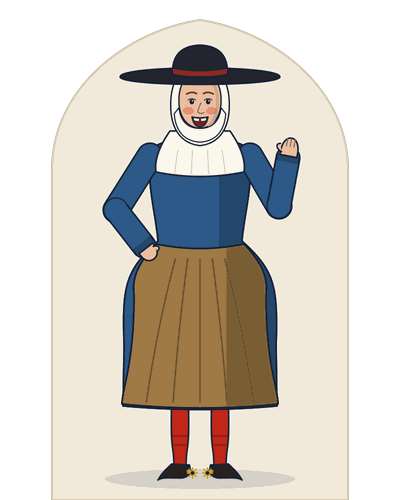
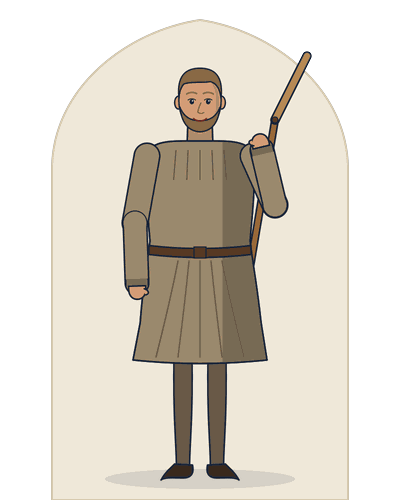
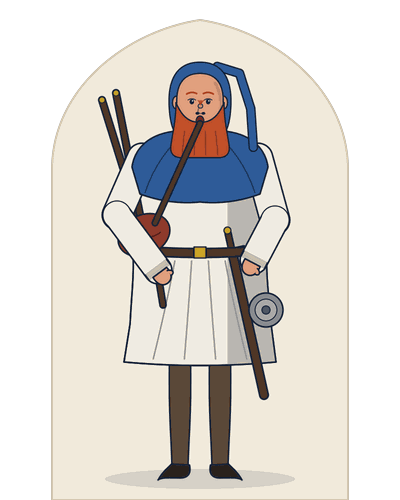
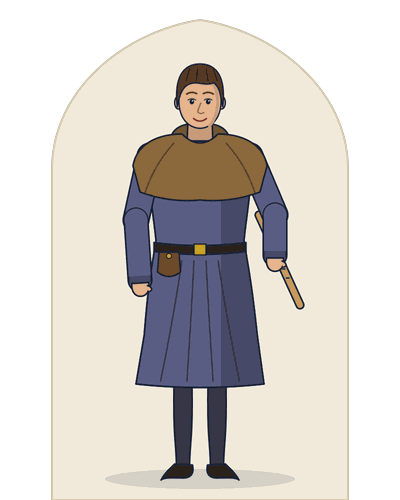
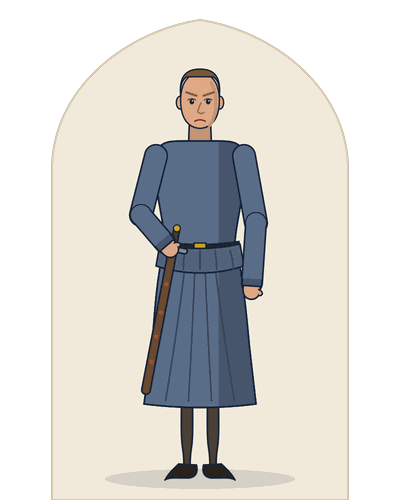
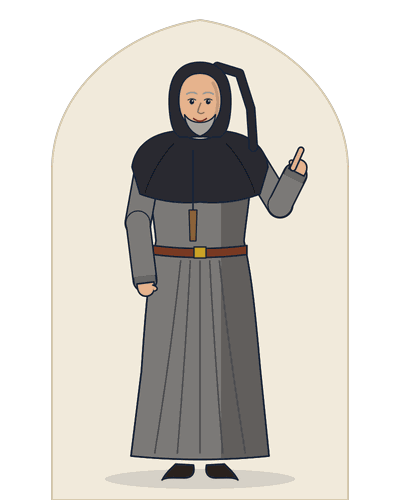
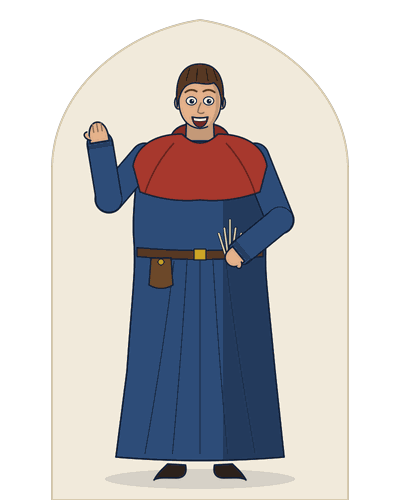
The book has 26 original drawings in one house style: every pilgrim, from the Knight to the Pardoner, with the narrator and the Host. Each is drawn from Chaucer’s own description; the narrator follows the early portrait of Chaucer in the Ellesmere manuscript.
Knighthood
The Church and learning
Professions and trade
Working people
Outside the portraits
General Prologue essay questions and answers: the twelve essays
The book answers the twelve questions examiners set most often on the General Prologue with twelve model essays. Each is written in full for long papers, with a marked cut line where a shorter answer can stop. These are the topics:
- The General Prologue as a picture of fourteenth-century English society
- Chaucer’s art of characterisation: are the pilgrims individuals or types?
- Chaucer and the Church: the Monk, the Friar, the Summoner and the Pardoner
- The ideal characters: the Knight, the Parson, the Ploughman and the Clerk
- The opening lines: nature, spring and pilgrimage
- Irony, satire and humour in the General Prologue
- Chaucer as “the father of English poetry”
- The narrator: Chaucer the pilgrim and Chaucer the poet
- Women in the General Prologue: the Prioress and the Wife of Bath
- The frame: the plan of the Tales and the part of the Host
- Chaucer’s style: his English, his verse and the heroic couplet
- Money and the new middle class
Pages from the book
Four pages as they appear in the book: the title page, a character card, a page of text with modern English, and model answers. Select a page to see it larger.
General Prologue questions students ask
Short, direct answers taken from the General Prologue study guide itself.
Who are the pilgrims in the General Prologue?
The pilgrims are the Knight, the Squire, the Yeoman, the Prioress with a second nun and three priests, the Monk, the Friar, the Merchant, the Clerk, the Sergeant of the Law, the Franklin, five Guildsmen and their Cook, the Shipman, the Doctor of Physic, the Wife of Bath, the Parson, the Ploughman, the Miller, the Manciple, the Reeve, the Summoner and the Pardoner. The narrator rides with them, and the Host of the Tabard Inn becomes their guide and the judge of their storytelling game.
How many pilgrims are there in the General Prologue?
Twenty-nine, by the narrator’s own count: “Wel nyne and twenty in a companye” (line 24). Count the people the portraits describe, with the Prioress’s three priests, and you reach thirty; add the narrator and you reach thirty-one. In the exam, write “twenty-nine by the narrator’s count, about thirty in all”.
Does this book include the full text of the General Prologue?
Yes. It prints the complete General Prologue, lines 1 to 858, from Skeat’s edition (Oxford, 1900), in 24 units. Every line of Chaucer’s Middle English has a plain modern English line under it, with word notes beneath each passage.
Is there a modern English translation of every line?
Yes. Line 1, “Whan that Aprille with his shoures sote”, becomes “When April with its sweet showers”, and the word notes beneath explain “shoures sote” as sweet showers. Every line of the poem is treated the same way, so you never have to guess what Chaucer means.
What are the main themes of the General Prologue?
The book follows six themes: pilgrimage, society, appearance against reality (which the book calls the mask), the Church, money and love. Every point on a character card carries its theme tag, and each theme leads to the essays that need it, such as the Church to the essay on the Monk, the Friar, the Summoner and the Pardoner.
Which General Prologue essay questions come up most often?
The book’s twelve model essays answer the questions examiners set most often, among them the Prologue as a picture of fourteenth-century society, Chaucer’s characterisation, Chaucer and the Church, the ideal characters, irony and satire, the narrator, and women in the Prologue. Each essay is written in full for long papers, with a marked cut line where a shorter answer can stop.
Are Chaucer’s pilgrims individuals or types?
Both, the book argues. The ideal and minor pilgrims lean towards the type, while the Wife of Bath and the Pardoner lean towards the individual; in most portraits a calling and a person are joined, and that union is why the pilgrims still seem alive.
Will the line numbers match my edition?
Almost always. The book prints Skeat’s text, whose line numbers are the same as in most modern editions except for two extra lines in the Friar’s portrait, which Skeat numbers 252b and 252c and some editions call 252a and 252b. Every quotation carries its line number: (72) means line 72.
Read the Wife of Bath unit free
The free PDF sample has the title page, A Note from the Author, the contents and the whole of Unit 15: The Wife of Bath, as it appears in the book.