Free sample unit · Hamlet study guide: Act 3, Scene 1: To be, or not to be, and the nunnery scene
This is Unit 8 of the Hamlet study guide, complete and free to read online: Act 3, Scene 1, with a plain modern English line under every line and word notes, then the To be, or not to be soliloquy in a model critical note, three short answers, a model context answer and five objective questions, as the book gives them, with the keys from the end of the book.
Unit 8 · Act 3, Scene 1
To Be, or Not to Be
Act 3, Scene 1 · A room in the castle
Claudius and Polonius hide to watch Hamlet meet Ophelia. Hamlet, alone as he believes, weighs life against death, then turns on Ophelia.
Unit 8 · Act 3, Scene 1 (188 lines) · The most-set soliloquy · Spies at court · The nunnery · Essays 4, 6, 11, 12
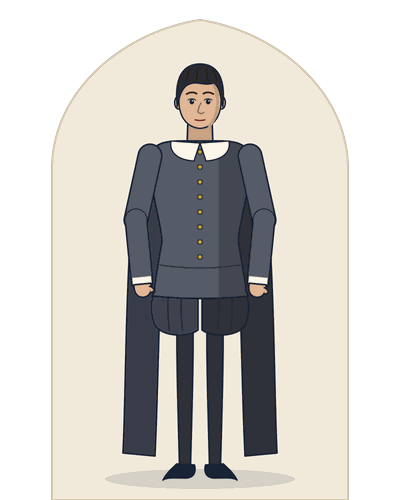
Hamlet, drawn for this book from the play.
- Claudius’s conscience speaks for the first time: “How smart a lash that speech doth give my conscience!” (3.1.50).
- Hamlet weighs life against death: “To be, or not to be: that is the question” (3.1.56).
- Hamlet turns on Ophelia while her father listens: “Get thee to a nunnery” (3.1.121).
Examiners ask
- Critically analyse the “To be, or not to be” soliloquy. Answer: Critical note
- Why is Hamlet so cruel to Ophelia in this scene? Answer: Short answer 2
- Explain lines 56 to 60 of Act 3, Scene 1 with reference to the context. Answer: Context answer
The still centre of the play: Hamlet thinks aloud while the court watches him.
Context
Suicide and the Church. In the play, taking one’s own life breaks God’s law, and a suicide may be refused full Christian burial (5.1.1-5, 5.1.216-219). Hamlet has already wished that God had not “fix’d / His canon ’gainst self-slaughter” (1.2.131-132). The question returns at Ophelia’s burial, where the Priest says “her death was doubtful” (5.1.215).
The text: Act 3, Scene 1 with modern English
The whole scene, as the book prints it: every line of the Cambridge text with its line number, a plain modern English line beneath it, and word notes after each passage.
Spies, a soliloquy and the nunnery Act 3, Scene 1 · Lines 1 to 188
A room in the castle.
Enter KING, QUEEN, POLONIUS, OPHELIA, ROSENCRANTZ, and GUILDENSTERN.
Claudius
And can you, by no drift of circumstance,
And can you not, by steering the talk in any way,
Get from him why he puts on this confusion,
Get out of him why he puts on this confused state,
Grating so harshly all his days of quiet
Jarring so harshly all his peaceful days
With turbulent and dangerous lunacy?
With wild and dangerous madness?
Rosencrantz
He does confess he feels himself distracted,
He does admit he feels his mind is disturbed,
But from what cause he will by no means speak.
But what has caused it he will not say at all.
Guildenstern
Nor do we find him forward to be sounded;
Nor do we find him willing to be questioned;
But, with a crafty madness, keeps aloof,
But, with a cunning madness, he keeps his distance
When we would bring him on to some confession
When we try to lead him on to some admission
Of his true state.
Of how he really is.
Gertrude
Did he receive you well?
Did he receive you well?
Rosencrantz
Most like a gentleman.
Very much like a gentleman.
Guildenstern
But with much forcing of his disposition.
But with a great effort against his mood.
Rosencrantz
Niggard of question, but of our demands
He asked few questions, but to our questions
Most free in his reply.
He was very free in his answers.
Gertrude
Did you assay him
Did you try to tempt him
To any pastime?
To any amusement?
Words1 drift of circumstance: steering of the conversation · 14 assay: try to tempt
Rosencrantz
Madam, it so fell out that certain players
Madam, it so happened that some actors
We o’er-raught on the way: of these we told him,
We overtook on the way: we told him about them,
And there did seem in him a kind of joy
And there did seem to be in him a kind of joy
To hear of it: they are about the court,
To hear of it: they are here at court,
And, as I think, they have already order
And, I believe, they have already been ordered
This night to play before him.
Tonight to perform before him.
Polonius
’Tis most true:
That is quite true:
And he beseech’d me to entreat your majesties
And he begged me to ask your majesties
To hear and see the matter.
To hear and see the play.
Claudius
With all my heart; and it doth much content me
With all my heart; and it pleases me greatly
To hear him so inclined.
To hear that he is in this mood.
Good gentlemen, give him a further edge,
Good gentlemen, sharpen his appetite further,
And drive his purpose on to these delights.
And push his interest on towards these pleasures.
Rosencrantz
We shall, my lord.
We will, my lord.
Exeunt Rosencrantz and Guildenstern.
Claudius
Sweet Gertrude, leave us too;
Sweet Gertrude, leave us as well;
For we have closely sent for Hamlet hither,
For we have secretly sent for Hamlet to come here,
That he, as ’twere by accident, may here
So that he, as if by chance, may here
Affront Ophelia:
Come face to face with Ophelia:
Her father and myself, lawful espials,
Her father and I, as rightful spies,
Will so bestow ourselves that, seeing unseen,
Will place ourselves so that, seeing without being seen,
We may of their encounter frankly judge,
We may judge their meeting freely,
And gather by him, as he is behaved,
And work out from him, by the way he behaves,
If’t be the affliction of his love or no
Whether or not it is the pain of his love
That thus he suffers for.
That he is suffering from like this.
Gertrude
I shall obey you:
I will obey you:
And for your part, Ophelia, I do wish
And as for you, Ophelia, I do wish
That your good beauties be the happy cause
That your fine beauty may be the happy cause
Of Hamlet’s wildness: so shall I hope your virtues
Of Hamlet’s wildness: then I shall hope your good qualities
Will bring him to his wonted way again,
Will bring him back to his usual ways again,
To both your honours.
To the credit of you both.
Ophelia
Madam, I wish it may.
Madam, I wish it may.
Exit Queen.
Words31 Affront: meet face to face · 32 espials: spies
Polonius
Ophelia, walk you here. Gracious, so please you,
Ophelia, you walk here. Your Majesty, if you please,
To Ophelia
We will bestow ourselves. Read on this book;
We will hide ourselves. Read from this book;
That show of such an exercise may colour
So that the look of such devotion may explain
Your loneliness. We are oft to blame in this,—
Your being alone. We are often to blame in this,
’Tis too much proved—that with devotion’s visage
It is shown far too often, that with a face of devotion
And pious action we do sugar o’er
And holy-seeming actions we sugar-coat
The devil himself.
The devil himself.
Claudius
Aside
O, ’tis too true!
Oh, it is too true!
How smart a lash that speech doth give my conscience!
What a sharp lash that speech gives my conscience!
The harlot’s cheek, beautied with plastering art,
The prostitute’s cheek, made beautiful with layers of make-up,
Is not more ugly to the thing that helps it
Is no uglier beside the paint that improves it
Than is my deed to my most painted word:
Than my deed is beside my falsely painted words:
O heavy burthen!
Oh, heavy burden!
Polonius
I hear him coming: let’s withdraw, my lord.
I hear him coming: let us withdraw, my lord.
Exeunt King and Polonius. Enter HAMLET.
Hamlet
To be, or not to be: that is the question:
To live, or not to live: that is the question:
Whether ’tis nobler in the mind to suffer
Whether it is nobler in the mind to endure
The slings and arrows of outrageous fortune,
The stones and arrows of cruel fortune,
Or to take arms against a sea of troubles,
Or to take up weapons against an ocean of troubles,
And by opposing end them? To die: to sleep;
And by fighting them, end them? To die: to sleep;
No more; and by a sleep to say we end
Nothing more; and to say that by a sleep we end
The heart-ache, and the thousand natural shocks
The heartache, and the thousand natural blows
That flesh is heir to, ’tis a consummation
That the body inherits, that is an ending
Devoutly to be wish’d. To die, to sleep;
To be wished for with all our hearts. To die, to sleep;
To sleep: perchance to dream: ay, there’s the rub;
To sleep: maybe to dream: yes, that is the snag;
For in that sleep of death what dreams may come,
For in that sleep of death what dreams may come,
When we have shuffled off this mortal coil,
When we have shaken off this turmoil of mortal life,
Must give us pause: there’s the respect
Must make us stop and think: that is the consideration
That makes calamity of so long life;
That gives disaster such a long life;
For who would bear the whips and scorns of time,
For who would bear the lashes and insults of the times,
The oppressor’s wrong, the proud man’s contumely,
The tyrant’s injustice, the proud man’s contempt,
The pangs of despised love, the law’s delay,
The pains of rejected love, the slowness of the law,
The insolence of office, and the spurns
The rudeness of officials, and the kicks
That patient merit of the unworthy takes,
That patient merit suffers from the unworthy,
When he himself might his quietus make
When he himself could settle his own account
With a bare bodkin? who would fardels bear,
With a mere dagger? Who would carry burdens,
To grunt and sweat under a weary life,
To grunt and sweat under a weary life,
But that the dread of something after death,
Except that the dread of something after death,
The undiscover’d country from whose bourn
The unexplored country from whose borders
No traveller returns, puzzles the will,
No traveller returns, confuses the will,
And makes us rather bear those ills we have
And makes us prefer to bear the troubles we have
Than fly to others that we know not of?
Than rush to others that we know nothing about?
Thus conscience does make cowards of us all,
So conscience makes cowards of us all,
And thus the native hue of resolution
And so the natural colour of determination
Is sicklied o’er with the pale cast of thought,
Is made sickly by the pale shade of thought,
And enterprises of great pitch and moment
And undertakings of great height and importance
With this regard their currents turn awry
Because of this thinking turn aside from their course
And lose the name of action. Soft you now!
And lose the name of action. Quiet now!
The fair Ophelia! Nymph, in thy orisons
The lovely Ophelia! Nymph, in your prayers
Be all my sins remember’d.
May all my sins be remembered.
Ophelia
Good my lord,
My good lord,
How does your honour for this many a day?
How has your honour been for all these many days?
Words45 colour: give a reason for, explain · 58 slings: stones thrown from slings · 63 consummation: ending, completion · 65 rub: obstacle (a term from bowls) · 67 mortal coil: turmoil of mortal life · 71 contumely: insulting scorn · 75 quietus: settling of an account; release by death · 76 bodkin: dagger · 76 fardels: burdens, bundles · 79 bourn: boundary, border · 83 conscience: awareness, reflection; also moral sense · 86 pitch: height (of a falcon’s flight) · 88 Soft you now!: quiet now; wait! · 89 orisons: prayers
Hamlet
I humbly thank you: well, well, well.
I humbly thank you: well, well, well.
Ophelia
My lord, I have remembrances of yours,
My lord, I have keepsakes of yours
That I have longed long to re-deliver;
That I have long wanted to give back;
I pray you, now receive them.
Please, take them now.
Hamlet
No, not I;
No, not me;
I never gave you aught.
I never gave you anything.
Ophelia
My honour’d lord, you know right well you did;
My honoured lord, you know very well you did;
And with them words of so sweet breath composed
And with them, words made of such sweet breath
As made the things more rich: their perfume lost,
That they made the gifts more precious: now their perfume is gone,
Take these again; for to the noble mind
Take these back; for to the noble mind
Rich gifts wax poor when givers prove unkind.
Rich gifts grow poor when the givers turn unkind.
There, my lord.
There, my lord.
Hamlet
Ha, ha! are you honest?
Ha, ha! Are you chaste?
Ophelia
My lord?
My lord?
Hamlet
Are you fair?
Are you beautiful?
Ophelia
What means your lordship?
What does your lordship mean?
Words93 remembrances: keepsakes, love tokens · 103 honest: chaste; also truthful · 105 fair: beautiful; also honest, just
Hamlet
That if you be honest and fair, your honesty
That if you are chaste and beautiful, your chastity
should admit no discourse to your beauty.
should allow no dealings with your beauty.
Ophelia
Could beauty, my lord, have better commerce
Could beauty, my lord, have better company
than with honesty?
than chastity?
Hamlet
Ay, truly; for the power of beauty will sooner
Yes, truly; for the power of beauty will sooner
transform honesty from what it is to a bawd than the force
turn chastity from what it is into a brothel-keeper than the strength
of honesty can translate beauty into his likeness: this was
of chastity can change beauty into its own likeness: this was
sometime a paradox, but now the time gives it proof. I
once a paradox, but now the present age proves it. I
did love you once.
did love you once.
Ophelia
Indeed, my lord, you made me believe so.
Indeed, my lord, you made me believe so.
Hamlet
You should not have believed me; for virtue
You should not have believed me; for virtue
cannot so inoculate our old stock but we shall relish of it:
cannot be grafted onto our old stock without our still tasting of it:
I loved you not.
I did not love you.
Ophelia
I was the more deceived.
I was all the more deceived.
Hamlet
Get thee to a nunnery: why wouldst thou be a
Go to a nunnery: why would you be a
breeder of sinners? I am myself indifferent honest; but yet
breeder of sinners? I myself am fairly virtuous; but still
I could accuse me of such things that it were better my
I could accuse myself of such things that it would be better if my
mother had not borne me: I am very proud, revengeful,
mother had never given birth to me: I am very proud, vengeful,
ambitious; with more offences at my beck than I have
ambitious; with more sins ready at my call than I have
thoughts to put them in, imagination to give them shape,
thoughts to put them in, imagination to give them shape,
or time to act them in. What should such fellows as I do
or time to carry them out. What should fellows like me be doing,
crawling between heaven and earth? We are arrant knaves
crawling between heaven and earth? We are complete rogues,
all; believe none of us. Go thy ways to a nunnery.
all of us; believe none of us. Off you go to a nunnery.
Where’s your father?
Where is your father?
Words112 bawd: brothel-keeper, procurer · 118 inoculate: graft, as a bud onto a tree · 118 relish of: taste of, keep a trace of · 121 nunnery: convent; perhaps also slang for brothel · 122 indifferent honest: reasonably virtuous · 128 arrant knaves: complete rogues
Ophelia
At home, my lord.
At home, my lord.
Hamlet
Let the doors be shut upon him, that he may
Let the doors be shut on him, so that he can
play the fool no where but in’s own house. Farewell.
play the fool nowhere but in his own house. Goodbye.
Ophelia
O, help him, you sweet heavens!
Oh, help him, sweet heavens!
Hamlet
If thou dost marry, I’ll give thee this plague for
If you do marry, I will give you this curse as
thy dowry: be thou as chaste as ice, as pure as snow, thou
your dowry: be as chaste as ice, as pure as snow, you
shalt not escape calumny. Get thee to a nunnery, go: farewell.
will not escape slander. Go to a nunnery, go: goodbye.
Or, if thou wilt needs marry, marry a fool; for wise
Or, if you really must marry, marry a fool; for wise
men know well enough what monsters you make of them.
men know well enough what monsters you make of them.
To a nunnery, go; and quickly too. Farewell.
To a nunnery, go; and quickly too. Goodbye.
Ophelia
O heavenly powers, restore him!
Oh, heavenly powers, make him well again!
Hamlet
I have heard of your paintings too, well enough;
I have heard about your painted faces too, quite enough;
God hath given you one face, and you make yourselves
God has given you one face, and you make yourselves
another: you jig, you amble, and you lisp, and nick-name
another: you skip about, you mince along, you lisp, and give new names to
God’s creatures, and make your wantonness your ignorance.
God’s creatures, and pretend your flirting comes from innocence.
Go to, I’ll no more on’t; it hath made me mad.
Enough, I will have no more of it; it has made me mad.
I say, we will have no more marriages: those that are married
I say, we will have no more marriages: those who are married
already, all but one, shall live; the rest shall keep as
already, all except one, shall live; the rest shall stay as
they are. To a nunnery, go.
they are. To a nunnery, go.
Exit.
Words137 calumny: slander · 139 monsters: cuckolds, husbands with unfaithful wives · 145 wantonness: loose or affected behaviour
Ophelia
O, what a noble mind is here o’erthrown!
Oh, what a noble mind is ruined here!
The courtier’s, soldier’s, scholar’s, eye, tongue, sword:
The courtier’s, soldier’s, scholar’s eye, tongue, sword:
The expectancy and rose of the fair state,
The hope and flower of this fair kingdom,
The glass of fashion and the mould of form,
The mirror of good style and the model of good behaviour,
The observed of all observers, quite, quite down!
The one watched by all who watch, quite, quite fallen!
And I, of ladies most deject and wretched,
And I, the most downcast and miserable of ladies,
That suck’d the honey of his music vows,
Who sucked the honey of his musical vows,
Now see that noble and most sovereign reason,
Now see that noble and most commanding reason
Like sweet bells jangled, out of tune and harsh;
Like sweet bells clashing, out of tune and harsh;
That unmatch’d form and feature of blown youth
That matchless figure and face of youth in full bloom
Blasted with ecstasy: O, woe is me,
Blighted by madness: oh, how miserable I am,
To have seen what I have seen, see what I see!
To have seen what I have seen, and see what I see!
Re-enter KING and POLONIUS.
Claudius
Love! his affections do not that way tend;
Love! His feelings do not lean that way;
Nor what he spake, though it lack’d form a little,
Nor was what he said, though it lacked order a little,
Was not like madness. There’s something in his soul
Like madness. There is something in his soul
O’er which his melancholy sits on brood,
Over which his melancholy sits like a hen on eggs,
And I do doubt the hatch and the disclose
And I do fear that what hatches and comes out
Will be some danger: which for to prevent,
Will be some danger: and to prevent that,
I have in quick determination
I have, by a quick decision,
Thus set it down:—he shall with speed to England,
Settled it like this: he shall go quickly to England
For the demand of our neglected tribute:
To demand the tribute they owe us and have not paid:
Haply the seas and countries different
Perhaps the seas and different countries,
With variable objects shall expel
With their varied sights, will drive out
This something-settled matter in his heart,
This somewhat fixed matter in his heart,
Whereon his brains still beating puts him thus
On which his brain, always beating, makes him so
From fashion of himself. What think you on ’t?
Unlike his normal self. What do you think of it?
Words152 expectancy and rose: hope and finest flower · 153 glass of fashion: mirror that others copy for style · 160 ecstasy: madness · 165 sits on brood: sits like a hen on eggs · 166 doubt: fear · 170 tribute: payment owed by a weaker state
Polonius
It shall do well: but yet do I believe
It will work well: but still I believe
The origin and commencement of his grief
The origin and beginning of his sorrow
Sprung from neglected love. How now, Ophelia!
Sprang from unreturned love. Well now, Ophelia!
You need not tell us what Lord Hamlet said;
You do not need to tell us what Lord Hamlet said;
We heard it all. My lord, do as you please;
We heard it all. My lord, do as you please;
But, if you hold it fit, after the play,
But, if you think it right, after the play,
Let his queen mother all alone entreat him
Let his mother the queen, all alone, beg him
To show his grief: let her be round with him;
To reveal his sorrow: let her be blunt with him;
And I’ll be placed, so please you, in the ear
And I will be placed, if you agree, within hearing
Of all their conference. If she find him not,
Of all their talk. If she does not find him out,
To England send him, or confine him where
Send him to England, or shut him up wherever
Your wisdom best shall think.
Your wisdom thinks best.
Claudius
It shall be so:
It shall be so:
Madness in great ones must not unwatch’d go.
Madness in great people must not go unwatched.
Exeunt.
Words183 round: plain-spoken, blunt · 185 find him not: does not discover his secret
Critical note: the To be, or not to be soliloquy
Critically analyse the “To be, or not to be” soliloquy.
Critical note · about 300 words
Answer. “To be, or not to be” (3.1.56-88) is Hamlet’s most famous soliloquy, a speech in which a character, alone on stage or unheard by others, speaks his thoughts aloud. It turns his private problem into a question about every human life: is it nobler to bear suffering or to end it?
The speech moves in clear stages. First Hamlet sets out the choice: to “suffer / The slings and arrows of outrageous fortune” or “to take arms against a sea of troubles” (3.1.57-59). Death looks like sleep, “a consummation / Devoutly to be wish’d” (3.1.63-64). Then the image turns against him: “To sleep: perchance to dream: ay, there’s the rub” (3.1.65). The dreams that may come after death make us stop.
Next he lists the burdens all people carry: “The pangs of despised love, the law’s delay, / The insolence of office” (3.1.72-73). Anyone could end them “With a bare bodkin” (3.1.76), a mere dagger. Only “the dread of something after death, / The undiscover’d country from whose bourn / No traveller returns” (3.1.78-80) keeps us alive.
The conclusion widens to all action: “Thus conscience does make cowards of us all” (3.1.83). Here “conscience” means both the moral sense and simple awareness. Resolution is “sicklied o’er with the pale cast of thought” (3.1.85), and great plans “lose the name of action” (3.1.88).
The technique matters. Hamlet never says “I” in the speech: he speaks of “we” and “us”, so it sounds like a general meditation, not a plan. Dramatic irony, where the audience knows more than the speaker, frames it: he believes he is alone, yet Claudius and Polonius are hidden and listening (3.1.43-55).
Verdict: the soliloquy shows the reflective mind that delays action, and it is the key evidence for any answer on Hamlet’s delay.
313 words
Short answers
What does Claudius’s aside “How smart a lash that speech doth give my conscience!” (3.1.50) reveal?
5 marks · short answer
Answer. The aside, a remark the other characters do not hear, reveals that Claudius is guilty and that his conscience still works. It is the first time he admits a crime, though only to the audience. Polonius has just said that “with devotion’s visage / And pious action we do sugar o’er / The devil himself” (3.1.47-49). The remark strikes home. Claudius compares himself to a prostitute who covers her face with paint: “The harlot’s cheek, beautied with plastering art” (3.1.51) is no uglier than “my deed to my most painted word” (3.1.53). His fine public words are the paint on his crime. The aside confirms the Ghost’s story for the audience before the play within the play tests it, and it prepares for his prayer in 3.3.
132 words
Why is Hamlet so cruel to Ophelia in this scene?
5 marks · short answer
Answer. Hamlet’s cruelty has several causes, and a good answer weighs them. First, Ophelia has obeyed her father and rejected him; now she returns his gifts and calls him unkind: “Rich gifts wax poor when givers prove unkind” (3.1.101). Second, he may sense that they are watched. His sudden question, “Where’s your father?” (3.1.130), and her untrue reply, “At home, my lord” (3.1.131), mark the turn to fury. Third, his disgust with his mother spreads to all women: “God hath given you one face, and you make yourselves another” (3.1.143-144). The harsh “Get thee to a nunnery” (3.1.121) may also be a bitter wish to keep her from a world of “arrant knaves” (3.1.128). Ophelia is the innocent victim.
130 words
Common mistake
The mistake. Writing that Hamlet speaks “To be, or not to be” to Ophelia, or that he is planning Claudius’s murder in it.
The correction. He speaks alone, as he believes, before he sees Ophelia (3.1.88-89), and he never mentions Claudius or revenge: the speech asks whether life is worth bearing at all.
Why it costs marks. Examiners mark down an answer that misplaces a passage or misreads what it is about.
What does Ophelia’s speech “O, what a noble mind is here o’erthrown!” (3.1.150-161) show?
5 marks · short answer
Answer. Ophelia’s speech shows what Hamlet was before his grief, as she remembers him. He had the “courtier’s, soldier’s, scholar’s, eye, tongue, sword” (3.1.151): the ideal Renaissance prince, skilled in manners, arms and learning. He was “The glass of fashion and the mould of form, / The observed of all observers” (3.1.153-154), the model others copied. Now his reason sounds “Like sweet bells jangled, out of tune and harsh” (3.1.158). The speech also shows Ophelia herself: loyal, blaming no one, “of ladies most deject and wretched” (3.1.155). She believes his madness is real. Claudius, who overheard Hamlet’s words to her, decides that what Hamlet said “Was not like madness” (3.1.164).
118 words
Context answer
Lines 56 to 60
To be, or not to be: that is the question:
Whether ’tis nobler in the mind to suffer
The slings and arrows of outrageous fortune,
Or to take arms against a sea of troubles,
And by opposing end them? (3.1.56-60)
Reference to context · 200 to 250 words
Answer.
Reference. These lines open the most famous of Hamlet’s soliloquies, in Act 3, Scene 1 of Hamlet by William Shakespeare. Hamlet speaks, alone as he believes.
Context. Just before, Claudius and Polonius have hidden to watch Hamlet meet Ophelia, who is given a book to read so that she seems to be alone (3.1.43-55). At the end of the soliloquy, Hamlet sees her: “Soft you now! / The fair Ophelia!” (3.1.88-89).
Explanation. Hamlet asks whether it is better to live or not to live. Is it nobler to endure the blows of bad luck, or to fight a whole sea of troubles and, by fighting, end them? The images come from war: “slings and arrows” are weapons, and “take arms” means fight. To take arms against the sea is a mixed metaphor, two images that do not fit together, since no one can defeat the sea; the impossible fight hints that ending the troubles means ending the life. The question has no “I”: it is put in general terms, so it speaks for everyone. Antithesis, the balance of opposites in “To be, or not to be”, sets the pattern of the whole speech.
Critical comment. The lines turn Hamlet’s private crisis into the human question of whether life is worth its pain, and they show the thinking mind behind his delay.
224 words
Objective questions
Choose one answer. The keys, from the end of the book, follow the questions.
36. Hamlet speaks “To be, or not to be” (3.1.56):
(a) to Ophelia
(b) to Horatio
(c) alone, as he believes, while others listen in hiding
(d) to the Players
37. In “With a bare bodkin” (3.1.76), a bodkin is:
(a) a dagger
(b) a bare hand
(c) a poison
(d) a rope
38. Claudius’s aside “How smart a lash that speech doth give my conscience!” (3.1.50) answers a remark by:
(a) Gertrude
(b) Polonius
(c) Rosencrantz
(d) Ophelia
39. “The undiscover’d country from whose bourn / No traveller returns” (3.1.79-80) is:
(a) England
(b) Wittenberg
(c) death and what follows it
(d) Norway
40. Statement I: Ophelia tells Hamlet that her father is at home.
Statement II: Polonius is in fact hidden nearby, listening.
(a) Both statements are correct
(b) Both statements are incorrect
(c) Statement I is correct, Statement II is incorrect
(d) Statement I is incorrect, Statement II is correct
Keys
36. (c) alone, as he believes, while others listen in hiding. Claudius and Polonius have hidden (3.1.55); Hamlet sees Ophelia only at 3.1.88-89.
37. (a) a dagger. A bodkin is a short dagger; “bare” means mere, or unsheathed.
38. (b) Polonius. Polonius has just said that a show of devotion can “sugar o’er / The devil himself” (3.1.48-49).
39. (c) death and what follows it. The country is the world after death; “bourn” means boundary.
40. (a) Both statements are correct. “At home, my lord” (3.1.131), while Polonius and Claudius listen: “We heard it all” (3.1.180).
This was Unit 8 of Hamlet: Exam Edition
The full book has 17 units like this one, 12 model essays, 145 objective questions and a bank of 48 quotations. The free PDF sample has this unit as it appears in the book, with the title page, A Note from the Author and the contents.