Free sample unit · General Prologue study guide: The Wife of Bath: lines 445 to 476
This is Unit 15 of the General Prologue study guide, complete and free to read online: the Wife of Bath, lines 445 to 476, with a plain modern English line under every line of Chaucer and word notes, then a model critical note, three short answers, a model context answer and five objective questions, as the book gives them, with the keys from the end of the book.
Unit 15 · Lines 445 to 476
The Wife of Bath
A wealthy cloth-maker, five times married
A bold, deaf, gap-toothed cloth-maker from near Bath, five times wed, who has seen many great shrines and loves company.
Unit 15 · Lines 445-476 (32 lines) · Estate: the rising middle class (cloth trade) · The only laywoman among the pilgrims · Comic, double-edged · Essays 2, 9, 12
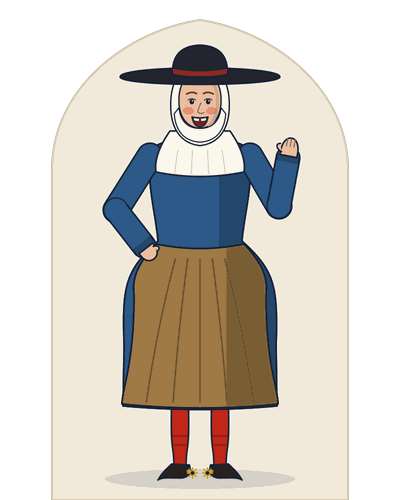
The Wife of Bath, drawn for this book from Chaucer’s description.
- Her trade gives her pride: “She passed hem of Ypres and of Gaunt” (448).
- Marriage as a career: “Housbondes at chirche-dore she hadde fyve” (460).
- Travelling and straying: “She coude muche of wandring by the weye” (467).
Examiners ask
- Write a critical note on the Wife of Bath. (Frequently set) Answer: Critical note
- How far does the Wife of Bath stand for a secular and a feminist position? Discuss. (Frequently set) Answer: Short answer 2
- Explain lines 453 to 458 with reference to the context. (Frequently set) Answer: Context answer
A worldly woman of huge energy: the type of the proud wife turned into a living person.
Context
Cloth, marriage and widows. Bath lay in a cloth-making region in the west of England. The finest cloth in Europe came from Flanders, from towns such as Ypres and Ghent, so to surpass them was the highest praise. Weddings took place at the church door: the couple made their vows in the porch and then went in for Mass. In law a married woman’s goods belonged to her husband, but a widow could own property and run a trade in her own name. A woman married five times might inherit from several husbands and grow rich.
The text: Lines 445 to 476 with modern English
The whole portrait, as the book prints it: every line of Skeat’s text with its line number, a plain modern English line beneath it, and word notes after each passage.
The Wife of Bath Lines 445 to 476
A good WYF was ther of bisyde BATHE,
There was a good WIFE from near BATH,
But she was som-del deef, and that was scathe.
Sadly, she was a little hard of hearing.
Of clooth-making she hadde swiche an haunt,
Her skill at weaving cloth was so great
She passed hem of Ypres and of Gaunt.
That she surpassed the weavers of Ypres and Ghent.
In al the parisshe wyf ne was ther noon
There was not a wife in her whole parish
That to the offring bifore hir sholde goon;
Who dared to go up with her offering ahead of her;
And if ther dide, certeyn, so wrooth was she,
And if anyone did, she was certainly so angry
That she was out of alle charitee.
That she lost all her charity.
Words445 bisyde: beside · 446 som-del deef: somewhat deaf · 446 scathe: a pity · 447 haunt: skill, practice · 448 passed: surpassed · 448 hem of: those of · 449 wyf: woman · 450 offring: offering at Mass · 450 bifore hir: before her · 451 wrooth: angry · 452 out of alle charitee: beyond all charity
Hir coverchiefs ful fyne were of ground;
Her headscarves were finely woven;
I dorste swere they weyeden ten pound
I dare swear they weighed ten pounds,
That on a Sonday were upon hir heed.
Those that were on her head on a Sunday.
Hir hosen weren of fyn scarlet reed,
Her stockings were a fine bright red,
Ful streite y-teyd, and shoos ful moiste and newe.
Tightly fastened, and her shoes were soft and new.
Bold was hir face, and fair, and reed of hewe.
Her face was bold and handsome, and red in colour.
Words453 coverchiefs: head-kerchiefs · 453 of ground: in texture · 454 dorste swere: dare swear · 454 weyeden: weighed · 456 hosen: stockings · 456 scarlet reed: scarlet red · 457 streite y-teyd: tightly tied · 457 moiste: supple · 458 reed of hewe: red in colour
She was a worthy womman al hir lyve,
All her life she was a woman of some importance;
Housbondes at chirche-dore she hadde fyve,
Five husbands she had married at the church door,
Withouten other companye in youthe;
Leaving aside the other company she kept when young;
But therof nedeth nat to speke as nouthe.
But we need not go into that at present.
And thryes hadde she been at Ierusalem;
And she had been to Jerusalem three times;
She hadde passed many a straunge streem;
She had crossed many a foreign river;
At Rome she hadde been, and at Boloigne,
She had been to Rome, and to Boulogne,
In Galice at seint Iame, and at Coloigne.
To Saint James in Galicia (Compostela), and to Cologne.
She coude muche of wandring by the weye.
She knew a great deal about wandering along the road.
Gat-tothed was she, soothly for to seye.
She was gap-toothed, to tell the truth.
Words459 worthy: respectable · 459 al hir lyve: all her life · 460 chirche-dore: church door · 461 Withouten: not counting · 461 other companye: other lovers · 462 therof: of that · 462 nedeth nat: there is no need · 462 as nouthe: just now · 463 thryes: three times · 464 passed: crossed · 464 straunge streem: foreign river · 466 Galice: Galicia (Spain) · 466 seint Iame: Saint James (Compostela) · 467 coude muche: knew much · 467 wandring by the weye: travelling; also straying from the right path · 468 Gat-tothed: gap-toothed · 468 soothly: truly
Up-on an amblere esily she sat,
She sat comfortably on an easy-paced horse,
Y-wimpled wel, and on hir heed an hat
Her head well wrapped in a wimple, and on her head a hat
As brood as is a bokeler or a targe;
Broad as a buckler or a round targe;
A foot-mantel aboute hir hipes large,
An outer skirt around her large hips,
And on hir feet a paire of spores sharpe.
And a pair of sharp spurs on her heels.
In felawschip wel coude she laughe and carpe.
In company she knew well how to laugh and chatter.
Of remedyes of love she knew per-chaunce,
She knew, as it happened, the remedies of love,
For she coude of that art the olde daunce.
For she knew all the old steps of that dance.
Words469 amblere: ambling horse · 470 Y-wimpled: wearing a wimple · 471 bokeler: buckler · 471 targe: round shield · 472 foot-mantel: riding skirt · 472 hipes: hips · 473 spores: spurs · 474 carpe: chatter, talk · 475 remedyes of love: cures for love · 475 per-chaunce: as it happened · 476 coude: knew · 476 olde daunce: old game, old tricks
Critical note: the Wife of Bath
Write a critical note on the Wife of Bath.
Critical note · about 300 words
Answer. The Wife of Bath is the most alive woman in the Prologue. Chaucer makes her live through a heap of solid detail that the narrator praises and the reader judges. She is the only laywoman among the pilgrims, a woman outside the Church, and she is drawn with every feature made bigger than life.
Her body tells her story. The narrator opens with praise, “A good WYF was ther of bisyde BATHE” (445), and at once adds a flaw: she is a little deaf (446). Her own Prologue, later in the Tales, explains that her fifth husband struck her on the ear. She is “Gat-tothed” (468), gap-toothed, which physiognomy, the old science of reading character from the face, took as a sign of a bold and loving nature. She has “hipes large” (472) and wears “a paire of spores sharpe” (473). Every detail can be seen and touched.
The praise carries a hidden criticism. She is “a worthy womman al hir lyve” (459), but her worth is counted in husbands. The narrator then refuses to speak of her “other companye in youthe” (461), and so makes the reader think of nothing else. Her charity fails if another wife goes first to the offering (451-452). She knows “the olde daunce” (476) of love, and experience, not innocence, is her pride.
Critics read her both as a type and as a person. Jill Mann showed that the portraits follow and transform estates satire, medieval writing that gave each class and calling its typical faults. Pride, show and a roving eye were the stock faults such writers gave to wives. Chaucer keeps them but gives her so much energy that she outgrows the type. Dryden saw the people of every age in the pilgrims: “We have our forefathers and great-grandames all before us, as they were in Chaucer’s days.”
Verdict: the Wife of Bath is the worldly wife of old satire made into a person, judged with a smile, not a sermon.
329 words
Short answers
What do the Wife of Bath’s cloth-making and her anger at the offering show?
5 marks · short answer
Answer. They show a woman whose pride rests on her success in trade and who carries that pride into church. Cloth-making was the great industry of her region, and she is so skilled that “She passed hem of Ypres and of Gaunt” (448). Ypres and Ghent were the famous cloth towns of Flanders, so the claim is a large boast, perhaps the narrator’s exaggeration. Her trade gives her money and standing. At Mass the people of a parish went up with their offerings in order of rank. No wife in her parish dares to go before her. If one does, she grows so angry that she loses all charity (451-452). The joke is sharp. Charity, the love of one’s neighbour, is the heart of Christian worship, and she loses it during worship over a question of rank. Success in business has become pride in church.
144 words
How far does the Wife of Bath stand for a secular and a feminist position? Discuss.
5 marks · short answer
Answer. The Wife of Bath represents a secular position fully and a feminist position only in part. Secular means concerned with this world, not with the Church. Her standing comes from trade and marriage, not from faith. Feminist, in the modern sense, means claiming equal rights for women. In favour of the claim, she earns her own money as a cloth-maker and has chosen five husbands (460). She rides with spurs, and “In felawschip wel coude she laughe and carpe” (474). In a society that asked women to be silent and obedient, that is real independence. Against the claim, the word feminist belongs to a much later age. She wants to go first at the offering, not to change the order of rank. A male narrator also draws her with old beliefs about women’s appetites. She is independent, but she has no plan to change the place of women.
148 words
Common mistake
The mistake. Writing that the Wife argues, in the General Prologue, that wives should rule their husbands.
The correction. That argument comes in her own Prologue, later in the Tales. In the General Prologue she does not speak; the narrator describes her (445-476).
Why it costs marks. A question on “The Prologue” wants evidence from these lines; quoting the wrong text weakens every point.
What do the Wife of Bath’s pilgrimages tell us about her?
5 marks · short answer
Answer. Her pilgrimages show a woman of wealth, courage and appetite for the world, for whom the road matters as much as the shrine. “And thryes hadde she been at Ierusalem” (463), a long, costly and dangerous journey that few people made even once. She has also seen Rome, Boulogne, the shrine of Saint James at Compostela in Galicia, and Cologne, which claimed the bones of the Three Kings (465-466). Only a woman with money and freedom could make such journeys. The next line holds a pun, a play on two meanings: she knew much “of wandring by the weye” (467). She knows a great deal about travelling, and also about straying from the right path. Her journeys seem to offer company and pleasure more than penance, the sorrow for sin that a pilgrimage was meant to show. Canterbury is one more stop on a long road.
146 words
Context answer
Lines 453 to 458
Hir coverchiefs ful fyne were of ground;
I dorste swere they weyeden ten pound
That on a Sonday were upon hir heed.
Hir hosen weren of fyn scarlet reed,
Ful streite y-teyd, and shoos ful moiste and newe.
Bold was hir face, and fair, and reed of hewe. (453-458)
Reference to context · 200 to 250 words
Answer.
Reference. These lines come from the portrait of the Wife of Bath in the General Prologue to The Canterbury Tales by Geoffrey Chaucer. She is a cloth-maker from near Bath and the only laywoman among the pilgrims. The narrator speaks.
Context. Just before, we learn that she outdoes the weavers of Ypres and Ghent and grows angry if any wife goes before her to the offering (447-452). Just after, the narrator calls her “a worthy womman” (459) and counts her five husbands (460).
Explanation. Her headcloths were finely woven; the narrator would swear that those she wore on a Sunday weighed ten pounds. Her stockings were of fine scarlet, tightly tied, and her shoes were soft and new. Her face was bold, handsome and red. “coverchiefs” (453) are headcloths, “hosen” (456) are stockings, and “moiste” (457) means supple, not wet. The technique is dress as character. The narrator promised to report each pilgrim’s “array” (41), and here the clothes speak. The oath “I dorste swere” (454) introduces hyperbole, deliberate exaggeration: ten pounds of linen on one head is absurd, and the absurdity measures her vanity. Sunday, the day of worship, becomes her day for display. Scarlet was a costly cloth, and the red of her stockings returns in her face. “Bold” (458) sums up both.
Critical comment. Six lines show a woman who dresses to be seen, even in church. Kittredge’s words on the whole Tales, in Chaucer and His Poetry (Harvard University Press, 1915), fit her: “The Pilgrims are not static: they move and live.”
256 words
Objective questions
Choose one answer. The keys, from the end of the book, follow the questions.
71. The Wife of Bath surpasses the cloth-makers of Ypres and Gaunt, towns in:
(a) Italy
(b) Spain
(c) France
(d) Flanders
72. How many husbands has the Wife of Bath married at the church door?
(a) three
(b) four
(c) five
(d) six
73. The Wife of Bath’s hat is as broad as:
(a) a buckler or a targe
(b) a spade
(c) a church door
(d) a ship’s sail
74. “Gat-tothed was she, soothly for to seye” (468) means that she was:
(a) toothless
(b) gap-toothed
(c) buck-toothed
(d) gold-toothed
75. “In Galice” (466) the Wife of Bath visited the shrine of:
(a) Saint Peter
(b) Saint Thomas
(c) Saint James
(d) Saint Julian
Keys
71. (d) Flanders. “She passed hem of Ypres and of Gaunt” (448): Ypres and Ghent were the great cloth towns of Flanders.
72. (c) five. “Housbondes at chirche-dore she hadde fyve” (460).
73. (a) a buckler or a targe. “As brood as is a bokeler or a targe” (471): a buckler and a targe are round shields.
74. (b) gap-toothed. Gap teeth were read in physiognomy as a sign of a bold, loving nature. See line 468.
75. (c) Saint James. “In Galice at seint Iame, and at Coloigne” (466): the shrine of Saint James at Compostela.
This was Unit 15 of The General Prologue to The Canterbury Tales: Exam Edition
The full book has 24 units like this one, 12 model essays, 180 objective questions and a bank of 40 quotations. The free PDF sample has this unit as it appears in the book, with the title page, A Note from the Author and the contents.