Free sample unit · Othello study guide: Act 5, Scene 2: “Put out the light, and then put out the light”
This is Unit 14 of the Othello study guide, complete and free to read online: Act 5, Scene 2, lines 1 to 170, Othello’s “Put out the light” scene at the bed of Desdemona, with a plain modern English line under every line of verse, the meaning of every prose speech and word notes, then a model critical note on the scene, three short answers, a model context answer and five objective questions, as the book gives them, with the keys from the end of the book.
Unit 14 · Act 5, Scene 2, lines 1 to 170
“Put Out the Light”
Act 5, Scene 2 · A bedchamber in the castle, at night
Othello kisses the sleeping Desdemona, wakes her, accuses her and smothers her. Emilia arrives too late, hears that Iago accused her, and cries murder.
Unit 14 · Act 5, Scene 2, lines 1 to 170 · Essays 1, 3, 4, 6, 12
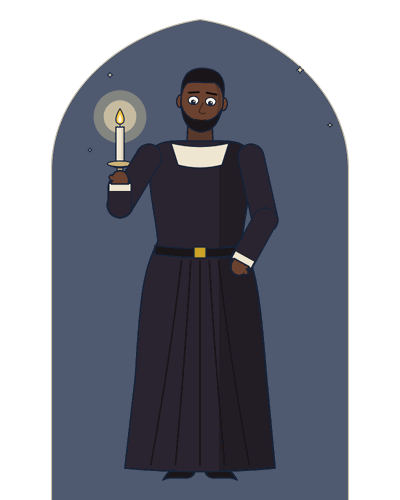
Othello, drawn for this book from the play.
- Othello’s resolve: “Put out the light, and then put out the light:” (5.2.7).
- Desdemona’s last lie: “Nobody; I myself.” (5.2.127).
- Emilia’s courage: “The Moor hath kill’d my mistress! Murder! murder!” (5.2.170).
Examiners ask
- Discuss Othello’s soliloquy at the start of Act 5, Scene 2. Answer: Critical note
- Why does Desdemona say “Nobody; I myself.”? Answer: Short answer 2
- Explain lines 1 to 15 of Act 5, Scene 2 with reference to the context. Answer: Context answer
Othello kills in the name of justice and love, and learns at once that he was wrong.
Context
A sacrifice or a murder? Othello enters believing that he is an instrument of justice, not a murderer: Desdemona “must die, else she’ll betray more men.” (5.2.6). He wants her to pray first so that he will not kill her soul, as a Christian executioner might. Desdemona calls his act what it is: “That death’s unnatural that kills for loving.” (5.2.44). When Othello says her lie has made him “call what I intend to do / A murder, which I thought a sacrifice:” (5.2.66-67), the whole moral question of the scene is in one sentence.
The text: Act 5, Scene 2, lines 1 to 170 with modern English
Lines 1 to 170 of the scene complete, as the book prints them: every line of the Cambridge text with its line number, a plain modern English line beneath each line of verse, a modern paragraph after each prose speech, and word notes after each passage.
The murder Act 5, Scene 2 · Lines 1 to 86
A bedchamber in the castle: DESDEMONA in bed asleep; a
light burning.
Enter OTHELLO.
Othello
It is the cause, it is the cause, my soul:
It is the cause, it is the cause, my soul:
Let me not name it to you, you chaste stars!
Let me not name it to you, you pure stars!
It is the cause. Yet I’ll not shed her blood,
It is the cause. Yet I will not shed her blood,
Nor scar that whiter skin of hers than snow
Nor scar that skin of hers, whiter than snow
And smooth as monumental alabaster.
And as smooth as the alabaster of a tomb.
Yet she must die, else she’ll betray more men.
Yet she must die, or she will betray more men.
Put out the light, and then put out the light:
Put out the light, and then put out the light:
If I quench thee, thou flaming minister,
If I put you out, you flaming servant,
I can again thy former light restore,
I can bring back your light again,
Should I repent me: but once put out thy light,
If I change my mind: but once I put out your light,
Thou cunning’st pattern of excelling nature,
You most skilful pattern of nature at its best,
I know not where is that Promethean heat
I do not know where to find that fire of Prometheus
That can thy light relume. When I have pluck’d the rose,
That can light you again. When I have picked the rose,
I cannot give it vital growth again,
I cannot give it the power to grow again,
It must needs wither: I’ll smell it on the tree.
It must wither: I will smell it on the tree.
Kissing her.
Ah, balmy breath, that dost almost persuade
Ah, sweet-scented breath, which almost persuades
Justice to break her sword! One more, one more:
Justice to break her sword! One more, one more:
Be thus when thou art dead, and I will kill thee,
Be like this when you are dead, and I will kill you,
And love thee after: one more, and this the last:
And love you afterwards: one more, and this is the last:
So sweet was ne’er so fatal. I must weep,
Nothing so sweet was ever so deadly. I must weep,
But they are cruel tears: this sorrow’s heavenly;
But they are cruel tears: this sorrow is like heaven’s;
It strikes where it doth love. She wakes.
It strikes where it loves. She is waking.
Words1 It is the cause: her supposed crime, the reason for this · 5 monumental alabaster: white stone used for tomb statues · 7 Put out the light: first the candle, then her life · 8 minister: servant (the candle) · 12 Promethean heat: the fire Prometheus stole from the gods · 13 relume: light again · 16 balmy: sweet-scented · 17 Justice to break her sword: Justice is pictured with sword and scales
Desdemona
Who’s there? Othello?
Who is there? Othello?
Othello
Ay, Desdemona.
Yes, Desdemona.
Desdemona
Will you come to bed, my lord?
Will you come to bed, my lord?
Othello
Have you pray’d to-night, Desdemona?
Have you said your prayers tonight, Desdemona?
Desdemona
Ay, my lord.
Yes, my lord.
Othello
If you bethink yourself of any crime
If you can think of any sin
Unreconciled as yet to heaven and grace,
Not yet forgiven by heaven and God’s grace,
Solicit for it straight.
Pray for forgiveness for it at once.
Desdemona
Alas, my lord, what may you mean by that?
Alas, my lord, what can you mean by that?
Othello
Well, do it, and be brief; I will walk by:
Well, do it, and be quick; I will walk nearby:
I would not kill thy unprepared spirit;
I would not kill your spirit while it is unprepared;
No; heaven forfend! I would not kill thy soul.
No; heaven forbid! I would not kill your soul.
Desdemona
Talk you of killing?
Are you talking about killing?
Othello
Ay, I do.
Yes, I am.
Desdemona
Then heaven have mercy on me!
Then heaven have mercy on me!
Othello
Amen, with all my heart!
Amen, with all my heart!
Words32 forfend: forbid
Desdemona
If you say so, I hope you will not kill me.
If you say that, I hope you will not kill me.
Othello
Hum!
Hmm!
Desdemona
And yet I fear you; for you are fatal then
And yet I am afraid of you; for you are deadly
When your eyes roll so: why I should fear I know not,
When your eyes roll like that: why I should be afraid I do not know,
Since guiltiness I know not; but yet I feel I fear.
Since I know I am not guilty; but still I feel afraid.
Othello
Think on thy sins.
Think about your sins.
Desdemona
They are loves I bear to you.
They are the love I have for you.
Othello
Ay, and for that thou diest.
Yes, and for that you die.
Desdemona
That death’s unnatural that kills for loving.
It is an unnatural death that kills for loving.
Alas, why gnaw you so your nether lip?
Alas, why are you biting your lower lip like that?
Some bloody passion shakes your very frame:
Some bloody passion is shaking your whole body:
These are portents; but yet I hope, I hope,
These are bad omens; but still I hope, I hope,
They do not point on me.
They do not point at me.
Othello
Peace, and be still!
Quiet, and be still!
Desdemona
I will so. What’s the matter?
I will. What is the matter?
Othello
That handkerchief which I so loved and gave thee
That handkerchief which I loved so much and gave to you,
Thou gavest to Cassio.
You gave to Cassio.
Desdemona
No, by my life and soul!
No, by my life and soul!
Send for the man, and ask him.
Send for the man, and ask him.
Othello
Sweet soul, take heed,
Sweet soul, be careful,
Take heed of perjury; thou art on thy death-bed.
Be careful of lying under oath; you are on your deathbed.
Words47 portents: bad omens · 53 perjury: lying on oath
Desdemona
Ay, but not yet to die.
Yes, but not to die yet.
Othello
Yes, presently:
Yes, very soon:
Therefore confess thee freely of thy sin;
So confess your sin openly;
For to deny each article with oath
For to deny each charge on oath
Cannot remove nor choke the strong conception
Cannot remove or stifle the strong belief
That I do groan withal. Thou art to die.
That makes me groan. You are going to die.
Desdemona
Then Lord have mercy on me!
Then Lord have mercy on me!
Othello
I say, amen.
I say amen.
Desdemona
And have you mercy too! I never did
And may you have mercy too! I never
Offend you in my life; never loved Cassio
Wronged you in my life; never loved Cassio
But with such general warranty of heaven
Except with the ordinary love that heaven allows
As I might love: I never gave him token.
Me to feel: I never gave him a love token.
Othello
By heaven, I saw my handkerchief in ’s hand.
By heaven, I saw my handkerchief in his hand.
O perjured woman! thou dost stone my heart,
Oh, lying woman! You turn my heart to stone,
And makest me call what I intend to do
And make me call what I mean to do
A murder, which I thought a sacrifice:
A murder, when I thought it was a sacrifice:
I saw the handkerchief.
I saw the handkerchief.
Desdemona
He found it then;
Then he found it;
I never gave it him: send for him hither;
I never gave it to him: send for him to come here;
Let him confess a truth.
Let him confess the truth.
Othello
He hath confess’d.
He has confessed.
Words56 article: charge · 57 conception: belief, plan · 62 warranty: permission · 65 stone my heart: turn my heart to stone
Desdemona
What, my lord?
What, my lord?
Othello
That he hath used thee.
That he has slept with you.
Desdemona
How? unlawfully?
What? Unlawfully?
Othello
Ay.
Yes.
Desdemona
He will not say so.
He will not say so.
Othello
No, his mouth is stopp’d;
No, his mouth is shut for good;
Honest Iago hath ta’en order for’t.
Honest Iago has seen to it.
Desdemona
O, my fear interprets! what, is he dead?
Oh, my fear tells me what that means! What, is he dead?
Othello
Had all his hairs been lives, my great revenge
If every hair on his head had been a life, my great revenge
Had stomach for them all.
Had appetite enough for them all.
Desdemona
Alas, he is betray’d, and I undone!
Alas, he has been betrayed, and I am ruined!
Othello
Out, strumpet! weep’st thou for him to my face?
Get away, whore! Do you weep for him to my face?
Desdemona
O, banish me, my lord, but kill me not!
Oh, banish me, my lord, but do not kill me!
Othello
Down, strumpet!
Down, whore!
Desdemona
Kill me to-morrow; let me live to-night!
Kill me tomorrow; let me live tonight!
Othello
Nay, if you strive,—
No, if you struggle —
Words75 ta’en order for’t: seen to it, arranged it
Desdemona
But half an hour!
Just half an hour!
Othello
Being done, there is no pause.
Now it has begun, there is no stopping.
Desdemona
But while I say one prayer!
Just while I say one prayer!
Othello
It is too late.
It is too late.
He stifles her.
Emilia’s discovery Act 5, Scene 2 · Lines 87 to 170
Emilia
Within
My lord, my lord! what, ho! my lord, my lord!
My lord, my lord! Hello, there! My lord, my lord!
Othello
What noise is this? Not dead? not yet quite dead?
What noise is this? Not dead? Not quite dead yet?
I that am cruel am yet merciful;
Cruel as I am, I am still merciful;
I would not have thee linger in thy pain:
I would not have you linger in your pain:
So, so.
So, so.
Emilia
Within
What, ho! my lord, my lord!
Hello, there! My lord, my lord!
Othello
Who’s there?
Who is there?
Emilia
Within
O, good my lord, I would speak a word with you!
Oh, my good lord, I want to speak a word with you!
Othello
Yes: ’tis Emilia. By and by. She’s dead.
Yes: it is Emilia. In a moment. She is dead.
’Tis like she comes to speak of Cassio’s death.
She is probably coming to tell me about Cassio’s death.
The noise was here. Ha! no more moving?
The noise was here. Ha! No more moving?
Still as the grave. Shall she come in? were ’t good?
As still as the grave. Shall she come in? Would it be wise?
I think she stirs again. No. What’s best to do?
I think she is moving again. No. What is the best thing to do?
If she come in, she’ll sure speak to my wife:
If she comes in, she will surely speak to my wife:
My wife! my wife! what wife? I have no wife.
My wife! My wife! What wife? I have no wife.
O, insupportable! O heavy hour!
Oh, unbearable! Oh, dreadful hour!
Methinks it should be now a huge eclipse
It seems to me there should now be a huge eclipse
Of sun and moon, and that the affrighted globe
Of the sun and moon, and that the terrified earth
Should yawn at alteration.
Should split open at such a change.
Emilia
Within
I do beseech you
I beg you
That I may speak with you, O, good my lord!
To let me speak with you, oh, my good lord!
Words104 yawn: gape, split open
Othello
I had forgot thee: O, come in, Emilia.
I had forgotten you: oh, come in, Emilia.
Soft; by and by. Let me the curtains draw.
Wait; in a moment. Let me draw the bed curtains.
Where art thou?
Where are you?
Unlocks the door.
Enter EMILIA.
Othello
What’s the matter with thee now?
What is the matter with you now?
Emilia
O, my good lord, yonder’s foul murders done!
Oh, my good lord, foul murders have been done out there!
Othello
What, now?
What, now?
Emilia
But now, my lord.
Just now, my lord.
Othello
It is the very error of the moon;
It is the moon wandering off her course;
She comes more nearer earth than she was wont
She comes closer to the earth than she used to
And makes men mad.
And makes men mad.
Emilia
Cassio, my lord, hath kill’d a young Venetian
Cassio, my lord, has killed a young Venetian
Call’d Roderigo.
Called Roderigo.
Othello
Roderigo kill’d!
Roderigo killed!
And Cassio kill’d!
And Cassio killed!
Emilia
No, Cassio is not kill’d.
No, Cassio is not killed.
Othello
Not Cassio kill’d! then murder’s out of tune,
Cassio not killed! Then murder is out of tune,
And sweet revenge grows harsh.
And sweet revenge turns harsh.
Words112 error: wandering off course
Desdemona
O, falsely, falsely murder’d!
Oh, falsely, falsely murdered!
Emilia
Alas, what cry is that?
Alas, what cry is that?
Othello
That! what?
That! What?
Emilia
Out, and alas! that was my lady’s voice.
Oh, alas! That was my lady’s voice.
Help! help, ho! help! O lady, speak again!
Help! Help, there! Help! Oh lady, speak again!
Sweet Desdemona! O sweet mistress, speak!
Sweet Desdemona! Oh, sweet mistress, speak!
Desdemona
A guiltless death I die.
I die an innocent death.
Emilia
O, who hath done this deed?
Oh, who has done this deed?
Desdemona
Nobody; I myself. Farewell:
Nobody; I did it myself. Goodbye:
Commend me to my kind lord: O, farewell!
Give my love to my kind lord: oh, goodbye!
Dies.
Othello
Why, how should she be murder’d?
Why, how could she have been murdered?
Emilia
Alas, who knows?
Alas, who knows?
Othello
You heard her say herself, it was not I.
You heard her say herself that it was not me.
Emilia
She said so: I must needs report the truth.
She said so: I must report the truth.
Othello
She’s like a liar gone to burning hell:
She has gone like a liar to burning hell:
’Twas I that kill’d her.
It was I who killed her.
Emilia
O, the more angel she,
Oh, then she is all the more an angel,
And you the blacker devil!
And you the blacker devil!
Words127 Nobody; I myself: she protects Othello with a lie
Othello
She turn’d to folly and she was a whore.
She turned to wickedness and she was a whore.
Emilia
Thou dost belie her and thou art a devil.
You are telling lies about her, and you are a devil.
Othello
She was false as water.
She was as false as water.
Emilia
Thou art rash as fire, to say
You are as wild as fire to say
That she was false: O, she was heavenly true!
That she was false: oh, she was heavenly true!
Othello
Cassio did top her; ask thy husband else.
Cassio slept with her; ask your husband if you do not believe me.
O, I were damn’d beneath all depth in hell,
Oh, I would be damned to the lowest depths of hell
But that I did proceed upon just grounds
If I had not acted on just grounds
To this extremity. Thy husband knew it all.
In going to this extreme. Your husband knew all about it.
Emilia
My husband!
My husband!
Othello
Thy husband.
Your husband.
Emilia
That she was false to wedlock?
That she was unfaithful to her marriage?
Othello
Ay, with Cassio. Nay, had she been true,
Yes, with Cassio. No, if she had been true,
If heaven would make me such another world
Even if heaven had made me another world
Of one entire and perfect chrysolite,
Out of one whole, perfect precious stone,
I’ld not have sold her for it.
I would not have sold her for it.
Words137 false as water: water flows any way, unstable · 139 top: sleep with; a crude word · 148 chrysolite: a precious green stone
Emilia
My husband!
My husband!
Othello
Ay, ’twas he that told me first:
Yes, it was he who told me first:
An honest man he is, and hates the slime
He is an honest man, and he hates the slime
That sticks on filthy deeds.
That sticks to filthy deeds.
Emilia
My husband!
My husband!
Othello
What needs this iteration, woman? I say thy husband.
Why do you keep repeating it, woman? I said your husband.
Emilia
O mistress, villany hath made mocks with love!
Oh, mistress, villainy has made a mockery of love!
My husband say that she was false!
My husband said that she was unfaithful!
Othello
He, woman;
He, woman;
I say thy husband: dost understand the word?
I said your husband: do you understand the word?
My friend, thy husband, honest, honest Iago.
My friend, your husband, honest, honest Iago.
Emilia
If he say so, may his pernicious soul
If he says so, may his evil soul
Rot half a grain a day! he lies to the heart:
Rot a little every day! He lies right to his heart:
She was too fond of her most filthy bargain.
She was too much in love with her most filthy bargain.
Othello
Ha!
Ha!
Emilia
Do thy worst:
Do your worst:
This deed of thine is no more worthy heaven
This deed of yours deserves heaven no more
Than thou wast worthy her.
Than you deserved her.
Othello
Peace, you were best.
You had better be quiet.
Words153 iteration: repetition · 159 half a grain a day: a little every day · 160 filthy bargain: Othello; Emilia’s bitter word
Emilia
Thou hast not half that power to do me harm
You do not have half the power to hurt me
As I have to be hurt. O gull! O dolt!
That I have to bear being hurt. Oh, you dupe! Oh, you idiot!
As ignorant as dirt! thou hast done a deed—
As ignorant as dirt! You have done a deed —
I care not for thy sword; I’ll make thee known,
I do not care about your sword; I will expose you,
Though I lost twenty lives. Help! help, ho! help!
Even if I lost twenty lives. Help! Help, there! Help!
The Moor hath kill’d my mistress! Murder! murder!
The Moor has killed my mistress! Murder! Murder!
Enter MONTANO, GRATIANO, IAGO, and others.
Words166 gull: dupe, fool · 166 dolt: idiot
Critical note: the murder scene
Discuss Othello’s soliloquy at the start of Act 5, Scene 2. (Frequently set)
Critical note · about 300 words
Answer. Othello’s soliloquy over the sleeping Desdemona is one of the most beautiful and terrible speeches in Shakespeare. It shows a man who still loves deeply, who believes he is doing justice, and who is about to commit murder.
First, he sees himself as a priest or judge. He begins, “It is the cause, it is the cause, my soul:” (5.2.1), refusing to name her supposed crime to the “chaste stars!” (5.2.2). He will not shed her blood or scar her skin, “whiter skin of hers than snow / And smooth as monumental alabaster.” (5.2.4-5). The image of a tomb statue makes her already seem dead.
Second, he states his reason as justice: “Yet she must die, else she’ll betray more men.” (5.2.6). He believes he is protecting others.
Third, the central image is light. “Put out the light, and then put out the light:” (5.2.7) means first the candle, then her life. A candle can be lit again, but he knows no “Promethean heat” (5.2.12) can relight her. The image of the rose follows: once plucked, it cannot grow again, “I’ll smell it on the tree.” (5.2.15).
Fourth, love fights with resolve. He kisses her again and again: “One more, one more:” (5.2.17). He weeps: “this sorrow’s heavenly; / It strikes where it doth love.” (5.2.21-22). He compares himself to God, who punishes those he loves.
The speech restores the music of Othello’s early verse, so the audience feels the greatness of what is being destroyed. Yet his calm is a terrible self-deception. He calls murder a sacrifice and his jealousy justice.
Verdict: the soliloquy shows Othello at his most loving and most deluded, and it makes the murder a tragedy rather than a crime alone.
302 words
Short answers
How does Desdemona plead for her life?
5 marks · short answer
Answer. Desdemona pleads with innocence, then with desperation. She denies giving Cassio the handkerchief: “No, by my life and soul! / Send for the man, and ask him.” (5.2.51-52). She says her only sins are “loves I bear to you.” (5.2.42). When Othello says Cassio is dead, she weeps, “Alas, he is betray’d, and I undone!” (5.2.79), which he takes as guilt. Then she begs: “O, banish me, my lord, but kill me not!” (5.2.81), “Kill me to-morrow; let me live to-night!” (5.2.83), “But half an hour!” (5.2.85), and “But while I say one prayer!” (5.2.86). Each plea asks for less. Othello answers, “It is too late.” (5.2.86), and stifles her.
125 words
Why does Desdemona say “Nobody; I myself.”?
5 marks · short answer
Answer. Desdemona revives for a moment and tries to protect Othello. She cries, “O, falsely, falsely murder’d!” (5.2.120) and “A guiltless death I die.” (5.2.125). When Emilia asks, “O, who hath done this deed?” (5.2.126), she answers, “Nobody; I myself. Farewell: / Commend me to my kind lord:” (5.2.127-128). Her last words are a lie told out of love: she forgives her murderer and calls him “kind”. The moment shows her goodness at its highest. It also exposes Othello, who at first uses her words to deny the deed, then admits, “’Twas I that kill’d her.” (5.2.133). Her loyalty to death answers every charge Iago made.
114 words
How does Emilia respond when she learns the truth?
5 marks · short answer
Answer. Emilia responds with grief, fury and courage. When Othello confesses, she answers, “O, the more angel she, / And you the blacker devil!” (5.2.133-134). Learning that Iago accused her mistress, she repeats in horror, “My husband!” (5.2.143). She sees the truth at once: “villany hath made mocks with love!” (5.2.154). She curses Iago: “may his pernicious soul / Rot half a grain a day!” (5.2.158-159). She defies Othello’s sword: “Thou hast not half that power to do me harm / As I have to be hurt.” (5.2.165-166). Then she cries out to the house: “The Moor hath kill’d my mistress! Murder! murder!” (5.2.170). The obedient wife becomes the voice of truth.
120 words
Common mistake
The mistake. Writing that Othello stabs or poisons Desdemona.
The correction. He stifles her in her bed (the direction at 5.2.86, “He stifles her.”); the Folio says “Smothers her.” Iago had urged him to “strangle her in her bed,” (4.1.201).
Why it costs marks. The manner of death keeps his promise not to “shed her blood,” (5.2.3) and should be stated exactly.
Context answer
Act 5, Scene 2, lines 1 to 15
It is the cause, it is the cause, my soul:
Let me not name it to you, you chaste stars!
It is the cause. Yet I’ll not shed her blood,
Nor scar that whiter skin of hers than snow
And smooth as monumental alabaster.
Yet she must die, else she’ll betray more men.
Put out the light, and then put out the light:
If I quench thee, thou flaming minister,
I can again thy former light restore,
Should I repent me: but once put out thy light,
Thou cunning’st pattern of excelling nature,
I know not where is that Promethean heat
That can thy light relume. When I have pluck’d the rose,
I cannot give it vital growth again,
It must needs wither: I’ll smell it on the tree. (5.2.1-15)
Reference to context · 200 to 250 words
Answer.
Reference. These lines are spoken by Othello, alone with the sleeping Desdemona, at the start of Act 5, Scene 2 of Othello by William Shakespeare, in the bedchamber in the castle.
Context. Othello has heard Cassio’s cries and believes Iago has killed him. He has come to kill Desdemona.
Explanation. Othello says that “the cause”, her supposed crime, drives him, but he will not name it to the pure stars. He will not shed her blood or scar her skin, whiter than snow and smooth as the alabaster of a tomb. Yet she must die, or she will betray more men. He will put out the candle, then her life. A candle can be relit if he regrets it, but once her light is out, no fire like the one Prometheus stole from the gods can relight it. A plucked rose cannot grow again; he will smell it on the tree.
Critical comment. The speech is calm, slow and beautiful, in strong contrast with Othello’s broken prose in Act 4. Its images of whiteness, light and the rose stress Desdemona’s purity, which is the opposite of what he believes. The repeated “the cause” shows him persuading himself that murder is justice. The dramatic irony is total: he speaks of her betraying “more men” when she has betrayed none.
218 words
Objective questions
Choose one answer. The keys, from the end of the book, follow the questions.
66. What does Othello mean by “Put out the light, and then put out the light:”?
(a) He will put out two candles
(b) He will put out the candle and then end Desdemona’s life
(c) He will close the curtains and leave
(d) He will blind Iago
67. Match the speaker with the line:
A. “That death’s unnatural that kills for loving.”
B. “It is too late.”
C. “O, the more angel she, / And you the blacker devil!”
D. “Nobody; I myself.”
Speakers: 1. Othello
2. Desdemona
3. Emilia
(a) A-2, B-1, C-3, D-2
(b) A-1, B-1, C-3, D-2
(c) A-2, B-2, C-3, D-2
(d) A-2, B-1, C-2, D-3
68. Assertion (A): Othello asks Desdemona if she has prayed that night.
Reason (R): He does not want to kill her soul as well as her body.
(a) Both A and R are true, and R explains A
(b) Both A and R are true, but R does not explain A
(c) A is true, but R is false
(d) A is false, but R is true
69. Statement I: Emilia brings news that Cassio has killed Roderigo.
Statement II: Emilia tells Othello that Cassio is dead.
(a) Only I is true
(b) Only II is true
(c) Both are true
(d) Neither is true
70. Put these events in order:
I. Desdemona says, “A guiltless death I die.”
II. Othello kisses the sleeping Desdemona
III. Emilia calls at the door
IV. Othello stifles Desdemona
(a) II, IV, III, I
(b) II, III, IV, I
(c) IV, II, III, I
(d) II, IV, I, III
Keys
66. (b) He will put out the candle and then end Desdemona’s life. The first “light” is the candle, “thou flaming minister,” (5.2.8); the second is Desdemona’s life, which cannot be relit (5.2.10-13).
67. (a) A-2, B-1, C-3, D-2. Desdemona (5.2.44), Othello (5.2.86), Emilia (5.2.133-134), Desdemona (5.2.127).
68. (a) Both A and R are true, and R explains A. “Have you pray’d to-night, Desdemona?” (5.2.25); “I would not kill thy soul.” (5.2.32).
69. (a) Only I is true. “Cassio, my lord, hath kill’d a young Venetian / Call’d Roderigo.” (5.2.115-116); “No, Cassio is not kill’d.” (5.2.117).
70. (a) II, IV, III, I. The kiss (5.2.15-19), the murder (5.2.86), Emilia within (5.2.87), Desdemona’s last words (5.2.125).
This was Unit 14 of Othello: Exam Edition
The full book has 15 units like this one, 12 model essays, 115 objective questions and a bank of 40 key passages. The free PDF sample has this unit as it appears in the book, with the title page, A Note from the Author and the contents.