Free sample unit · King Lear study guide: Act 3, Scenes 1 to 3: the storm scene, “Blow, winds, and crack your cheeks”
This is Unit 7 of the King Lear study guide, complete and free to read online: the storm scene, Act 3, Scenes 1 to 3, with a plain modern English line under every line of verse, the meaning of every prose speech and word notes, then a model critical note on the storm scene, three short answers, a model context answer and five objective questions, as the book gives them, with the keys from the end of the book.
Unit 7 · Act 3, Scenes 1 to 3
The Storm: “Blow, Winds, and Crack Your Cheeks”
Act 3, Scenes 1 to 3 · The heath and Gloucester’s castle
Lear rages at a storm on the heath, with the Fool. Kent seeks help; Gloucester plans to aid the king.
Unit 7 · Act 3, Scenes 1 to 3 (55, 95 and 23 lines) · Essays 1, 5, 8, 10, 11
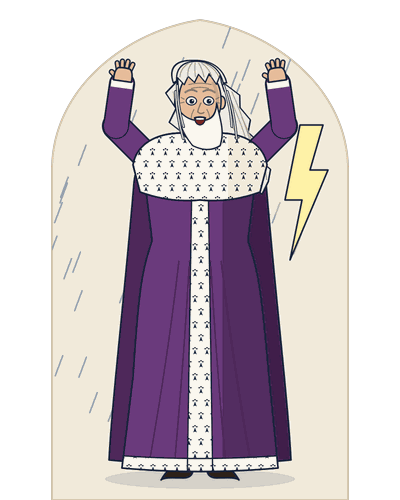
King Lear, drawn for this book from the play.
- Lear orders the storm on: “Blow, winds, and crack your cheeks! rage! blow!” (3.2.1).
- He cries out: “I am a man / More sinn’d against than sinning.” (3.2.59-60).
- Gloucester defies the dukes: “we must incline to the king” (3.3.12).
Examiners ask
- What is the significance of the storm scene in King Lear? Answer: Critical note
- What does the Fool do for Lear in the storm? Answer: Short answer 2
- Explain lines 1 to 9 of Act 3, Scene 2 with reference to the context. Answer: Context answer
The king commands the weather, and the weather teaches him he is only a man.
Context
The order of the heavens. Many critics read the storm against the Great Chain of Being, an old idea of the universe as a ladder of ranks, from the lowest kind of existence up to God, each thing in its place. In that reading, when Lear gives away his crown and his daughters turn on him, the order of nature seems to break as well. Lear calls on the gods to “Find out their enemies now” (3.2.51), but the storm does not obey a king who has given his power away.
The text: Act 3, Scenes 1 to 3 with modern English
All three scenes complete, as the book prints them: every line of the Cambridge text with its line number, a plain modern English line beneath each line of verse, a modern paragraph after each prose speech, and word notes after each passage.
Kent and the Gentleman on the stormy heath Act 3, Scene 1 · Lines 1 to 55
A heath.
Storm still. Enter KENT and a Gentleman, meeting.
Kent
Who’s there, besides foul weather?
Who is there, besides foul weather?
Gentleman
One minded like the weather, most unquietly.
One with a mind like the weather, very restless.
Kent
I know you. Where’s the king?
I know you. Where is the king?
Gentleman
Contending with the fretful elements;
Fighting with the angry elements;
Bids the wind blow the earth into the sea,
Tells the wind to blow the earth into the sea,
Or swell the curled waters ’bove the main,
Or swell the curling waters above the mainland,
That things might change or cease; tears his white hair,
So that things might change or cease; tears his white hair,
Which the impetuous blasts, with eyeless rage,
Which the violent gusts, with blind rage,
Catch in their fury, and make nothing of;
Seize in their fury, and treat as nothing;
Strives in his little world of man to out-scorn
Strives, in his own small world of a man, to show more scorn than
The to-and-fro-conflicting wind and rain.
The wind and rain that fight back and forth.
This night, wherein the cub-drawn bear would couch,
This night, when the starving mother bear would lie down,
The lion and the belly-pinched wolf
The lion and the starving wolf
Keep their fur dry, unbonneted he runs,
Keep their fur dry, he runs bare-headed,
And bids what will take all.
And tells whatever will to take it all.
Kent
But who is with him?
But who is with him?
Words6 main: the mainland, not the ocean · 10 little world of man: the human body seen as a tiny universe · 12 cub-drawn: hungry, drained by her cubs’ sucking · 15 bids what will take all: tells fate to take everything
Gentleman
None but the fool; who labours to out-jest
No one but the Fool, who works hard to joke away
His heart-struck injuries.
The wrongs that struck him to the heart.
Kent
Sir, I do know you;
Sir, I know you;
And dare, upon the warrant of my note,
And dare, on the strength of my knowledge of you,
Commend a dear thing to you. There is division,
Entrust a precious matter to you. There is a split,
Although as yet the face of it be cover’d
Although as yet its face is covered
With mutual cunning, ’twixt Albany and Cornwall;
With mutual cunning, between Albany and Cornwall;
Who have—as who have not, that their great stars
Who have—as who have not, whose great stars
Throned and set high?—servants, who seem no less,
Have given them thrones and set them high?—servants who seem no less,
Which are to France the spies and speculations
Who are for France the spies and watchers
Intelligent of our state; what hath been seen,
That report on our state; what has been seen,
Either in snuffs and packings of the dukes,
Either in quarrels and plots of the dukes,
Or the hard rein which both of them have borne
Or the hard rein both of them have held
Against the old kind king, or something deeper,
Against the old kind king, or something deeper,
Whereof perchance these are but furnishings,—
Of which these are perhaps only outward dressing—
But true it is, from France there comes a power
But it is true, from France there comes an army
Into this scatter’d kingdom; who already,
Into this divided kingdom; who already,
Wise in our negligence, have secret feet
Wise to our carelessness, have secret footholds
In some of our best ports, and are at point
In some of our best ports, and are on the point
To show their open banner. Now to you:
Of showing their open banner. Now to you:
If on my credit you dare build so far
If you dare trust my word so far
To make your speed to Dover, you shall find
As to make haste to Dover, you will find
Some that will thank you, making just report
Some who will thank you, giving a true report
Of how unnatural and bemadding sorrow
Of how unnatural and maddening a sorrow
The king hath cause to plain.
The king has cause to lament.
I am a gentleman of blood and breeding,
I am a gentleman of birth and breeding,
And from some knowledge and assurance offer
And from some knowledge and certainty offer
This office to you.
This service to you.
Words22 stars: the planets were thought to rule fortune
Gentleman
I will talk further with you.
I will talk further with you.
Kent
No, do not.
No, do not.
For confirmation that I am much more
To confirm that I am much more
Than my out-wall, open this purse and take
Than my outward show, open this purse and take
What it contains. If you shall see Cordelia,—
What it holds. If you see Cordelia—
As fear not but you shall,—show her this ring,
And do not doubt that you will—show her this ring,
And she will tell you who your fellow is
And she will tell you who your companion is,
That yet you do not know. Fie on this storm!
Whom you do not yet know. Shame on this storm!
I will go seek the king.
I will go and look for the king.
Gentleman
Give me your hand:
Give me your hand:
Have you no more to say?
Have you nothing more to say?
Kent
Few words, but, to effect, more than all yet;
Few words, but in effect more than all so far;
That when we have found the king,—in which your pain
That when we have found the king—in which your effort
That way, I’ll this,—he that first lights on him
goes that way, mine this—whoever first finds him
Holla the other.
should call to the other.
Exeunt severally.
Lear and the Fool in the storm Act 3, Scene 2 · Lines 1 to 95
Another part of the heath. Storm still.
Enter LEAR and Fool.
Lear
Blow, winds, and crack your cheeks! rage! blow!
Blow, winds, and burst your cheeks! Rage! Blow!
You cataracts and hurricanoes, spout
You floods and hurricanes, pour out
Till you have drench’d our steeples, drown’d the cocks!
Until you have soaked our steeples and drowned the weathercocks!
You sulphurous and thought-executing fires,
You sulphurous fires that act as quick as thought,
Vaunt-couriers to oak-cleaving thunderbolts,
Heralds of the oak-splitting thunderbolts,
Singe my white head! And thou, all-shaking thunder,
Singe my white head! And you, all-shaking thunder,
Smite flat the thick rotundity o’ the world!
Strike flat the thick roundness of the world!
Crack nature’s moulds, all germins spill at once
Break nature’s moulds, destroy all the seeds at once
That make ingrateful man!
That make ungrateful man!
Fool
O nuncle, court holy-water in a dry house is
better than this rain-water out o’ door. Good nuncle, in,
and ask thy daughters’ blessing: here’s a night pities
neither wise man nor fool.
Oh nuncle, holy water from court, in a dry house, is better than this rain water out of doors. Good nuncle, go in, and ask your daughters’ blessing: here is a night that pities neither wise man nor fool.
Lear
Rumble thy bellyful! Spit, fire! spout, rain!
Rumble your bellyful! Spit, fire! Pour, rain!
Nor rain, wind, thunder, fire, are my daughters:
Rain, wind, thunder and fire are not my daughters:
I tax not you, you elements, with unkindness;
I do not charge you, you elements, with unkindness;
I never gave you kingdom, call’d you children,
I never gave you a kingdom, called you children,
You owe me no subscription: then let fall
You owe me no obedience: so let fall
Your horrible pleasure; here I stand, your slave,
Your terrible will; here I stand, your slave,
A poor, infirm, weak and despised old man:
A poor, frail, weak and despised old man:
But yet I call you servile ministers,
But even so I call you servile helpers,
That have with two pernicious daughters join’d
Who have joined with two wicked daughters
Your high-engender’d battles ’gainst a head
Your battles bred in the sky, against a head
So old and white as this. O! O! ’tis foul!
As old and white as this. Oh! Oh! It is foul!
Words10 court holy-water: flattering words, which cost nothing · 16 unkindness: lack of natural, family feeling
Fool
He that has a house to put’s head in has a good
head-piece.
He who has a house to put his head in has a good head-covering.
The cod-piece that will house
The codpiece that will find a house
Before the head has any,
Before the head has any,
The head and he shall louse;
The head and he shall be lousy;
So beggars marry many.
So beggars marry many.
The man that makes his toe
The man who makes his toe
What he his heart should make
What he should make his heart
Shall of a corn cry woe,
Shall cry woe over a corn,
And turn his sleep to wake.
And turn his sleep to waking.
For there was never yet fair woman but she made mouths
in a glass.
For there was never yet a beautiful woman but she made faces in a mirror.
Lear
No, I will be the pattern of all patience;
No, I will be the pattern of all patience;
I will say nothing.
I will say nothing.
Enter KENT.
Kent
Who’s there?
Who is there?
Fool
Marry, here’s grace and a cod-piece; that’s a
wise man and a fool.
Indeed, here is grace and a codpiece; that is a wise man and a fool.
Words26 head-piece: helmet; also, a good brain · 27 cod-piece: pouch on men’s breeches; also, the penis · 33 corn: painful hard growth on the toe · 40 here’s grace and a cod-piece: the king (Lear) and the Fool
Kent
Alas, sir, are you here? things that love night
Alas, sir, are you here? Things that love night
Love not such nights as these; the wrathful skies
Do not love nights such as these; the wrathful skies
Gallow the very wanderers of the dark,
Frighten the very wanderers of the dark,
And make them keep their caves: since I was man,
And make them keep to their caves: since I was a man,
Such sheets of fire, such bursts of horrid thunder,
Such sheets of fire, such bursts of horrid thunder,
Such groans of roaring wind and rain, I never
Such groans of roaring wind and rain, I never
Remember to have heard: man’s nature cannot carry
Remember hearing: man’s nature cannot bear
The affliction nor the fear.
The suffering or the fear.
Lear
Let the great gods,
Let the great gods,
That keep this dreadful pother o’er our heads,
Who keep up this dreadful uproar over our heads,
Find out their enemies now. Tremble, thou wretch,
Now find out their enemies. Tremble, you wretch,
That hast within thee undivulged crimes,
Who have within you undisclosed crimes,
Unwhipp’d of justice: hide thee, thou bloody hand;
Not yet whipped by justice: hide, you bloody hand;
Thou perjured, and thou simular man of virtue
You perjurer, and you pretender to virtue
That art incestuous: caitiff, to pieces shake,
Who are incestuous: you villain, shake to pieces,
That under covert and convenient seeming
You who, under a hiding and convenient pretence,
Hast practised on man’s life: close pent-up guilts,
Have plotted against a man’s life: guilts shut tightly inside,
Rive your concealing continents and cry
Split open your hiding places and cry
These dreadful summoners grace. I am a man
mercy to these dreadful summoners. I am a man
More sinn’d against than sinning.
More sinned against than sinning.
Kent
Alack, bare-headed!
Alas, bare-headed!
Gracious my lord, hard by here is a hovel;
My gracious lord, close by here is a hovel;
Some friendship will it lend you ’gainst the tempest:
It will lend you some friendship against the tempest:
Repose you there; while I to this hard house—
Rest there; while I go to this hard house—
More harder than the stones whereof ’tis raised;
Harder than the stones it is built of;
Which even but now, demanding after you,
Which even just now, when I asked after you,
Denied me to come in—return, and force
Refused to let me in—return, and force
Their scanted courtesy.
Their scanty courtesy.
Lear
My wits begin to turn.
My wits begin to turn.
Come on, my boy: how dost, my boy? art cold?
Come on, my boy: how are you, my boy? Are you cold?
I am cold myself. Where is this straw, my fellow?
I am cold myself. Where is this straw, my fellow?
The art of our necessities is strange,
The art of our necessities is strange,
That can make vile things precious. Come, your hovel.
That can make vile things precious. Come, your hovel.
Poor fool and knave, I have one part in my heart
Poor fool and lad, I have one part in my heart
That’s sorry yet for thee.
That is still sorry for you.
Words59 summoners: officers who summoned sinners to church courts · 60 More sinn’d against than sinning: I have suffered more wrong than I did · 70 The art of our necessities: need teaches us to value poor things
Fool
Singing
He that has and a little tiny wit,—
He who has a little tiny wit—
With hey, ho, the wind and the rain,—
With hey, ho, the wind and the rain—
Must make content with his fortunes fit,
Must be content with the fortunes that suit him,
For the rain it raineth every day.
For the rain it rains every day.
Lear
True, my good boy. Come, bring us to this hovel.
True, my good boy. Come, bring us to this hovel.
Exeunt Lear and Kent.
Fool
This is a brave night to cool a courtezan. I’ll
speak a prophecy ere I go:
This is a fine night to cool a prostitute. I will speak a prophecy before I go:
When priests are more in word than matter;
When priests are more in word than substance;
When brewers mar their malt with water;
When brewers spoil their malt with water;
When nobles are their tailors’ tutors;
When nobles are their tailors’ teachers;
No heretics burn’d, but wenches’ suitors;
No heretics burned, but chasers of girls;
When every case in law is right;
When every case in law is right;
No squire in debt, nor no poor knight;
No squire in debt, nor any poor knight;
When slanders do not live in tongues,
When slanders do not live in tongues,
Nor cutpurses come not to throngs;
Nor pickpockets come into crowds;
When usurers tell their gold i’ the field,
When moneylenders count their gold in the open field,
And bawds and whores do churches build;
And brothel-keepers and whores build churches;
Then shall the realm of Albion
Then shall the realm of Albion
Come to great confusion:
Come to great confusion:
Then comes the time, who lives to see’t,
Then comes the time, for whoever lives to see it,
That going shall be used with feet.
That walking shall be done with feet.
This prophecy Merlin shall make; for I live before his time.
This prophecy Merlin shall make; for I live before his time.
Exit.
Words79 courtezan: prostitute; the cold storm cools her · 84 wenches’ suitors: men burned by disease, not by law · 91 Albion: old name for this island · 95 Merlin: Arthur’s legendary wizard, born long after Lear
Gloucester decides to help the king Act 3, Scene 3 · Lines 1 to 23
Gloucester’s castle.
Enter GLOUCESTER and EDMUND.
Gloucester
Alack, alack, Edmund, I like not this unnatural
dealing. When I desired their leave that I might pity him,
they took from me the use of mine own house; charged
me, on pain of their perpetual displeasure, neither to speak
of him, entreat for him, nor any way sustain him.
Alas, alas, Edmund, I do not like this unnatural treatment. When I asked their permission to pity him, they took from me the use of my own house; ordered me, on pain of their lasting anger, neither to speak of him, plead for him, nor help him in any way.
Edmund
Most savage and unnatural!
Most savage and unnatural!
Gloucester
Go to; say you nothing. There’s a division betwixt
the dukes, and a worse matter than that: I have received
a letter this night; ’tis dangerous to be spoken; I
have locked the letter in my closet: these injuries the king
now bears will be revenged home; there is part of a power
already footed: we must incline to the king. I will seek
him and privily relieve him: go you, and maintain talk
with the duke, that my charity be not of him perceived: if
he ask for me, I am ill and gone to bed. Though I die
for it, as no less is threatened me, the king my old master
must be relieved. There is some strange thing toward,
Edmund; pray you, be careful.
Enough; say nothing. There is a split between the dukes, and a worse matter than that: I have received a letter tonight; it is dangerous to speak of; I have locked the letter in my private room: these wrongs the king now suffers will be fully paid back; part of an army has already landed: we must side with the king. I will look for him and help him in secret: you go and keep the duke talking, so that he does not notice my kindness to the king: if he asks for me, say I am ill and gone to bed. Even if I die for it, as nothing less is threatened me, the king my old master must be helped. Something strange is about to happen, Edmund; please, be careful.
Exit.
Edmund
This courtesy, forbid thee, shall the duke
This kindness, which you were forbidden, the duke shall
Instantly know, and of that letter too:
know at once, and about that letter too:
This seems a fair deserving, and must draw me
This looks like a service worth rewarding, and must bring me
That which my father loses; no less than all:
what my father loses; nothing less than everything:
The younger rises when the old doth fall.
The young rise when the old fall.
Exit.
Critical note: the storm scene
What is the significance of the storm scene in King Lear?
Critical note · about 300 words
Answer. The storm scene (3.2) is significant because it turns Lear’s private suffering into a battle with the whole universe, and it begins both his madness and his pity. The weather is pathetic fallacy: nature that seems to share a character’s feelings.
First, the storm mirrors his mind. The Gentleman says Lear “Strives in his little world of man to out-scorn / The to-and-fro-conflicting wind and rain” (3.1.10-11). Lear then asks thunder to “Crack nature’s moulds, all germins spill at once / That make ingrateful man!” (3.2.8-9). Anger at two daughters becomes a wish to end all human life.
Second, the storm reverses his power. Once a giver of kingdoms, he cannot command the sky. He stands “your slave, / A poor, infirm, weak and despised old man” (3.2.19-20), yet calls the elements “servile ministers” (3.2.21), because they fight on his daughters’ side.
Third, it raises the question of justice. Lear asks the gods to find “undivulged crimes, / Unwhipp’d of justice” (3.2.52-53) and cries, “I am a man / More sinn’d against than sinning” (3.2.59-60). One reading hears self-pity, since Lear forgets his wrong to Cordelia; another hears the first sign that he can think of guilt beyond his own.
Fourth, madness and pity begin together. “My wits begin to turn” (3.2.67), yet at once he asks the Fool, “art cold?” (3.2.68). Hazlitt, in Characters of Shakespear’s Plays (R. Hunter and C. and J. Ollier, 1817), called the storm scene “grand and terrible” yet did not rank it among the finest; its worth lies in what it opens in Lear.
Verdict: the storm strips the king of power, shows him a man, and wakes his pity for others.
290 words
Short answers
What does the Gentleman’s report in Act 3, Scene 1 tell us about Lear and the kingdom?
5 marks · short answer
Answer. The report shows Lear in a storm of the mind and a kingdom close to civil war. The Gentleman says Lear is “Contending with the fretful elements” (3.1.4), and that only the Fool is with him, one who “labours to out-jest / His heart-struck injuries” (3.1.16-17). The scene also gives the politics. Kent tells him that “There is division” (3.1.19) between Albany and Cornwall, and that “from France there comes a power / Into this scatter’d kingdom” (3.1.30-31). Then Kent sends the Gentleman to Dover with a ring for Cordelia (3.1.47). So the storm is both inside Lear and over the state.
110 words
What does the Fool do for Lear in the storm?
5 marks · short answer
Answer. The Fool tries to keep Lear safe, and he tells him hard truths. He begs Lear to go indoors: “court holy-water in a dry house is / better than this rain-water out o’ door” (3.2.10-11). Court holy-water means flattering words, so he advises Lear to flatter his daughters rather than drown. He jokes that “He that has a house to put’s head in has a good / head-piece” (3.2.25-26): Lear gave away his house, and his sense went with it. Lear answers with the first warmth he shows: “Poor fool and knave, I have one part in my heart / That’s sorry yet for thee” (3.2.72-73). The Fool is loyal company and the voice of common sense.
120 words
Why is Gloucester’s talk with Edmund in Act 3, Scene 3 important?
5 marks · short answer
Answer. The scene shows Gloucester’s loyalty in action and, at the same moment, hands Edmund the means to ruin him. The dukes have forbidden Gloucester to help the king, and he calls this “unnatural / dealing” (3.3.1-2). Yet he decides, “we must incline to the king” (3.3.12). Edmund, alone, plans to betray him: “This courtesy, forbid thee, shall the duke / Instantly know, and of that letter too” (3.3.19-20). He ends: “The younger rises when the old doth fall.” (3.3.23). The scene joins the two stories that run side by side, Lear’s and Gloucester’s, and the father’s kindness will cost him dearly.
107 words
Common mistake
The mistake. Writing “I am a man more sinned against than sinning”, or giving the line to Gloucester or Edgar.
The correction. Lear says it in the storm: “I am a man / More sinn’d against than sinning.” (3.2.59-60), with the spelling “sinn’d” in this text. Kent answers at once: “Alack, bare-headed!” (3.2.60).
Why it costs marks. Examiners mark down a misquoted line or a line given to the wrong speaker.
Context answer
Act 3, Scene 2, lines 1 to 9
Blow, winds, and crack your cheeks! rage! blow!
You cataracts and hurricanoes, spout
Till you have drench’d our steeples, drown’d the cocks!
You sulphurous and thought-executing fires,
Vaunt-couriers to oak-cleaving thunderbolts,
Singe my white head! And thou, all-shaking thunder,
Smite flat the thick rotundity o’ the world!
Crack nature’s moulds, all germins spill at once
That make ingrateful man! (3.2.1-9)
Reference to context · 200 to 250 words
Answer.
Reference. These lines open Lear’s storm speech in Act 3, Scene 2 of King Lear by William Shakespeare. Lear speaks on the heath, with the Fool beside him, in the middle of the storm.
Context. His daughters have cut down his followers and left him out in the night. In the next lines the Fool urges him to go in (3.2.10-13), but Lear refuses.
Explanation. Lear orders the wind to blow until its “cheeks” burst, the rain to drown the church steeples, and the lightning to singe his white hair. He asks the thunder to flatten the round earth and to destroy “nature’s moulds” (3.2.8), the patterns from which human beings are made, so that no more ungrateful people are born. The speech uses apostrophe, which is speech to things as if they could hear, and personification, which gives human features, such as cheeks, to the wind. Hard words such as “Crack” and “Smite” make the verse sound like the thunder it calls for.
Critical comment. Lear commands the storm like a king, yet his wish is the end of the world, not only the punishment of two daughters. The speech shows grief that has outgrown reason. Soon he sees himself as “your slave” (3.2.19), a weak old man.
215 words
Objective questions
Choose one answer. The keys, from the end of the book, follow the questions.
31. In Act 3, Scene 1, Kent tells the Gentleman to show a ring to:
(a) Cordelia
(b) Albany
(c) Gloucester
(d) Edgar
32. Match the speaker with the line:
A. “Nor rain, wind, thunder, fire, are my daughters:” (3.2.15)
B. “He that has a house to put’s head in has a good / head-piece.” (3.2.25-26)
C. “Alas, sir, are you here? things that love night” (3.2.42)
D. “The younger rises when the old doth fall.” (3.3.23)
Speakers: 1. The Fool
2. Edmund
3. Lear
4. Kent
(a) A-3, B-1, C-2, D-4
(b) A-3, B-1, C-4, D-2
(c) A-1, B-3, C-4, D-2
(d) A-3, B-4, C-1, D-2
33. Assertion (A): Lear charges the elements with unkindness.
Reason (R): He says that he never gave the elements a kingdom or called them children.
(a) Both A and R are true, and R explains A
(b) Both A and R are true, but R does not explain A
(c) A is true, but R is false
(d) A is false, but R is true
34. Put these events in the order they happen:
I. Gloucester says he will help the king in secret
II. Kent sends the Gentleman to Dover
III. Lear says “My wits begin to turn.”
IV. Lear says “I will be the pattern of all patience”
(a) I, II, III, IV
(b) II, I, III, IV
(c) II, IV, III, I
(d) IV, II, I, III
35. Statement I: The dukes have forbidden Gloucester to help the king.
Statement II: Edmund promises to keep his father’s kindness secret.
(a) Only I is true
(b) Only II is true
(c) Both are true
(d) Neither is true
Keys
31. (a) Cordelia. Kent names Cordelia (3.1.46) and says “show her this ring” (3.1.47).
32. (b) A-3, B-1, C-4, D-2. Lear (3.2.15), the Fool (3.2.25-26), Kent (3.2.42) and Edmund (3.3.23) speak these lines.
33. (d) A is false, but R is true. “I tax not you, you elements, with unkindness” (3.2.16), because “I never gave you kingdom” (3.2.17).
34. (c) II, IV, III, I. Dover (3.1.36), patience (3.2.37), “My wits begin to turn” (3.2.67), then “we must incline to the king” (3.3.12).
35. (a) Only I is true. Gloucester may not “sustain him” (3.3.5), but Edmund says “shall the duke / Instantly know” (3.3.19-20).
This was Unit 7 of King Lear: Exam Edition
The full book has 15 units like this one, 12 model essays, 115 objective questions and a bank of 40 key passages. The free PDF sample has this unit as it appears in the book, with the title page, A Note from the Author and the contents.