Free sample unit · Jekyll and Hyde study guide: Chapter One, Story of the Door: Mr Utterson and Enfield’s tale
This is Unit 1 of the Jekyll and Hyde study guide, complete and free to read online: Chapter One, Story of the Door, paragraphs 1 to 28, with a plain modern English paragraph after every paragraph of Stevenson and word notes, then a model critical note on Mr Utterson, three short answers, a model context answer and five objective questions, as the book gives them, with the keys from the end of the book. The PDF sample holds Chapters One and Two, Units 1 and 2.
Unit 1 · Chapter One
Story of the Door: Mr Utterson and Enfield’s Tale
Chapter One · A London by-street, on a Sunday walk
On a Sunday walk Mr Enfield tells Mr Utterson how a strange man trampled a girl and paid with another man’s cheque.
Unit 1 · 28 paragraphs (2,394 words) · Essays 5, 6, 7, 10
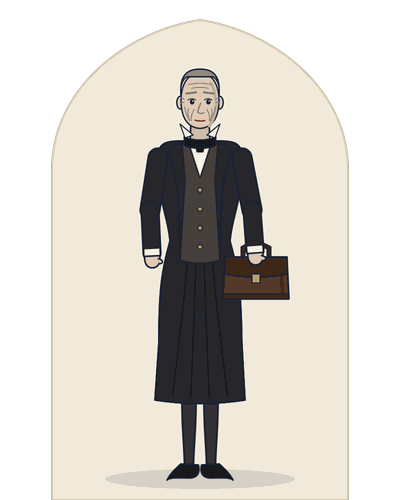
Mr Utterson, drawn for this book from the novel.
- Mr Utterson is dry and silent: “lean, long, dusty, dreary and yet somehow lovable.” (1.1).
- The man in Enfield’s story “trampled calmly over the child’s body” (1.8).
- Enfield’s rule: “the more it looks like Queer Street, the less I ask.” (1.14).
Examiners ask
- Character sketch of Mr Utterson in the opening chapter. Answer: Critical note
- How does Enfield’s story present the man who tramples the girl? Answer: Short answer 1
- Explain with reference to the context: “He is not easy to describe.” Answer: Context answer
A dry lawyer hears of a hateful man, and a mystery begins.
Context
Who tells the story. Chapter one has two voices. The narrator, the voice that tells the story, describes Mr Utterson and the street, and stays close to the lawyer. Then Enfield tells the story of the door in his own words (1.8). So the reader sees the man with the key only through Enfield’s eyes. Enfield talks in slang. “Sawbones” (1.8) means a doctor. “Queer Street” (1.14) is old slang for being in money trouble. The place is London: “a by-street in a busy quarter of London” (1.3). The reader does not yet know one fact. Enfield will not give the name on the cheque: “a name that I can’t mention” (1.8). Mr Utterson knows it, but he does not say it either (1.25).
The text: Chapter One with modern English
Chapter One, paragraphs 1 to 28, complete as the book prints them: every paragraph of the first edition with its number, a plain modern English paragraph after it, and word notes after each passage.
Mr Utterson Chapter One · Paragraphs 1 to 2
Story of the Door
Mr Utterson the lawyer is dry and silent, yet people trust him.
Mr. Utterson the lawyer was a man of a rugged countenance that was never lighted by a smile; cold, scanty and embarrassed in discourse; backward in sentiment; lean, long, dusty, dreary and yet somehow lovable. At friendly meetings, and when the wine was to his taste, something eminently human beaconed from his eye; something indeed which never found its way into his talk, but which spoke not only in these silent symbols of the after-dinner face, but more often and loudly in the acts of his life. He was austere with himself; drank gin when he was alone, to mortify a taste for vintages; and though he enjoyed the theatre, had not crossed the doors of one for twenty years. But he had an approved tolerance for others; sometimes wondering, almost with envy, at the high pressure of spirits involved in their misdeeds; and in any extremity inclined to help rather than to reprove. “I incline to Cain’s heresy,” he used to say quaintly: “I let my brother go to the devil in his own way.” In this character, it was frequently his fortune to be the last reputable acquaintance and the last good influence in the lives of downgoing men. And to such as these, so long as they came about his chambers, he never marked a shade of change in his demeanour.
Mr Utterson the lawyer had a rough face that was never lit by a smile. He was cold, sparing and awkward in talk, and slow to show feeling. He was lean, long, dusty and dreary, and yet somehow lovable. At friendly gatherings, when the wine was to his taste, something deeply human shone from his eye. It never found its way into his talk. But it spoke in these silent signs of his face after dinner, and more often and more loudly in the acts of his life. He was strict with himself. He drank gin when he was alone, to hold down a taste for fine wines. Though he enjoyed the theatre, he had not gone through the doors of one for twenty years. But he had a proven tolerance for others. He sometimes wondered, almost with envy, at the high energy that went into their wrongdoing. In any serious trouble he was more ready to help than to blame. “I lean towards Cain’s heresy,” he used to say in his odd way. “I let my brother go to the devil in his own way.” Being such a man, he often happened to be the last respectable acquaintance and last good influence in the lives of men going downhill. And as long as such men came to his rooms, he never showed the slightest change in his manner towards them.
Words1 vintages: fine wines from good years · 1 Cain’s heresy: Cain’s view: not his brother’s keeper · 1 chambers: rooms used as a home or an office
No doubt the feat was easy to Mr. Utterson; for he was undemonstrative at the best, and even his friendship seemed to be founded in a similar catholicity of good-nature. It is the mark of a modest man to accept his friendly circle ready-made from the hands of opportunity; and that was the lawyer’s way. His friends were those of his own blood or those whom he had known the longest; his affections, like ivy, were the growth of time, they implied no aptness in the object. Hence, no doubt the bond that united him to Mr. Richard Enfield, his distant kinsman, the well-known man about town. It was a nut to crack for many, what these two could see in each other, or what subject they could find in common. It was reported by those who encountered them in their Sunday walks, that they said nothing, looked singularly dull and would hail with obvious relief the appearance of a friend. For all that, the two men put the greatest store by these excursions, counted them the chief jewel of each week, and not only set aside occasions of pleasure, but even resisted the calls of business, that they might enjoy them uninterrupted.
No doubt this was easy for Mr Utterson, for he showed little feeling at the best of times. Even his friendships seemed to rest on the same good nature towards everyone. It is the mark of a modest man to accept his circle of friends ready-made, as chance hands it to him. That was the lawyer’s way. His friends were his own relations or those he had known the longest. His affections, like ivy, grew with time and did not mean that the person was specially suited to him. This, no doubt, explains the bond that tied him to Mr Richard Enfield, his distant relation, the well-known man about town. Many people found it a puzzle what these two could see in each other, or what subject they could share. People who met them on their Sunday walks reported that they said nothing and looked extremely dull. They would greet the appearance of a friend with obvious relief. All the same, the two men valued these outings very highly and counted them the chief jewel of each week. They not only gave up chances of pleasure but even refused calls of business, so that they could enjoy them without interruption.
Words2 catholicity: the quality of taking in everyone alike · 2 man about town: a fashionable man seen at social events
The street and the door Chapter One · Paragraphs 3 to 7
On a Sunday walk Mr Utterson and Mr Enfield pass a shabby door in a bright street.
It chanced on one of these rambles that their way led them down a by-street in a busy quarter of London. The street was small and what is called quiet, but it drove a thriving trade on the weekdays. The inhabitants were all doing well, it seemed, and all emulously hoping to do better still, and laying out the surplus of their gains in coquetry; so that the shop fronts stood along that thoroughfare with an air of invitation, like rows of smiling saleswomen. Even on Sunday, when it veiled its more florid charms and lay comparatively empty of passage, the street shone out in contrast to its dingy neighbourhood, like a fire in a forest; and with its freshly painted shutters, well-polished brasses, and general cleanliness and gaiety of note, instantly caught and pleased the eye of the passenger.
On one of these walks their way happened to lead them down a by-street in a busy part of London. The street was small and what is called quiet, but it did a thriving trade on weekdays. The people who lived there were all doing well, it seemed, and all hoping, as rivals, to do better still. They spent their spare profits on making their shops attractive. So the shop fronts stood along that street with an inviting air, like rows of smiling saleswomen. On Sunday it hid its showier charms and was fairly empty of people passing. Even then the street shone out against its dingy neighbourhood, like a fire in a forest. With its freshly painted shutters, well-polished brass and general cleanliness and cheerfulness, it at once caught and pleased the eye of the passer-by.
Two doors from one corner, on the left hand going east the line was broken by the entry of a court; and just at that point a certain sinister block of building thrust forward its gable on the street. It was two storeys high; showed no window, nothing but a door on the lower storey and a blind forehead of discoloured wall on the upper; and bore in every feature, the marks of prolonged and sordid negligence. The door, which was equipped with neither bell nor knocker, was blistered and distained. Tramps slouched into the recess and struck matches on the panels; children kept shop upon the steps; the schoolboy had tried his knife on the mouldings; and for close on a generation, no one had appeared to drive away these random visitors or to repair their ravages.
Two doors from one corner, on the left as you go east, the line of shops was broken by the entrance to a courtyard. Just at that point a certain sinister block of building pushed its end wall forward onto the street. It was two storeys high. It showed no window, only a door on the lower storey and a blind forehead of stained wall above. Every feature bore the marks of long and dirty neglect. The door had neither bell nor knocker, and it was blistered and stained. Tramps slouched into the doorway and struck matches on the panels. Children played at shops on the steps. The schoolboy had tried his knife on the woodwork. For nearly a generation no one had appeared to drive these chance visitors away or to repair their damage.
Words3 by-street: a side street off a main road · 3 quarter: a district of a town · 3 coquetry: flirting; here, dressing up to attract · 3 passenger: here, a person passing on foot · 4 court: a small yard with buildings round it
Mr. Enfield and the lawyer were on the other side of the by-street; but when they came abreast of the entry, the former lifted up his cane and pointed.
Mr Enfield and the lawyer were on the other side of the by-street. But when they came level with the entrance, Mr Enfield lifted his cane and pointed.
“Did you ever remark that door?” he asked; and when his companion had replied in the affirmative, “It is connected in my mind,” added he, “with a very odd story.”
“Did you ever notice that door?” he asked. When his companion had replied that he had, he added, “It is connected in my mind with a very odd story.”
“Indeed?” said Mr. Utterson, with a slight change of voice, “and what was that?”
“Indeed?” said Mr Utterson, with a slight change of voice, “and what was that?”
Enfield’s story Chapter One · Paragraphs 8 to 10
Enfield tells how a man trampled a girl and paid her family with another man’s cheque.
“Well, it was this way,” returned Mr. Enfield: “I was coming home from some place at the end of the world, about three o’clock of a black winter morning, and my way lay through a part of town where there was literally nothing to be seen but lamps. Street after street and all the folks asleep—street after street, all lighted up as if for a procession and all as empty as a church—till at last I got into that state of mind when a man listens and listens and begins to long for the sight of a policeman. All at once, I saw two figures: one a little man who was stumping along eastward at a good walk, and the other a girl of maybe eight or ten who was running as hard as she was able down a cross street. Well, sir, the two ran into one another naturally enough at the corner; and then came the horrible part of the thing; for the man trampled calmly over the child’s body and left her screaming on the ground. It sounds nothing to hear, but it was hellish to see. It wasn’t like a man; it was like some damned Juggernaut. I gave a view halloa, took to my heels, collared my gentleman, and brought him back to where there was already quite a group about the screaming child. He was perfectly cool and made no resistance, but gave me one look, so ugly that it brought out the sweat on me like running. The people who had turned out were the girl’s own family; and pretty soon, the doctor, for whom she had been sent, put in his appearance. Well, the child was not much the worse, more frightened, according to the Sawbones; and there you might have supposed would be an end to it. But there was one curious circumstance. I had taken a loathing to my gentleman at first sight. So had the child’s family, which was only natural. But the doctor’s case was what struck me. He was the usual cut and dry apothecary, of no particular age and colour, with a strong Edinburgh accent and about as emotional as a bagpipe. Well, sir, he was like the rest of us; every time he looked at my prisoner, I saw that Sawbones turn sick and white with the desire to kill him. I knew what was in his mind, just as he knew what was in mine; and killing being out of the question, we did the next best. We told the man we could and would make such a scandal out of this as should make his name stink from one end of London to the other. If he had any friends or any credit, we undertook that he should lose them. And all the time, as we were pitching it in red hot, we were keeping the women off him as best we could for they were as wild as harpies. I never saw a circle of such hateful faces; and there was the man in the middle, with a kind of black sneering coolness—frightened too, I could see that—but carrying it off, sir, really like Satan. ‘If you choose to make capital out of this accident,’ said he, ‘I am naturally helpless. No gentleman but wishes to avoid a scene,’ says he. ‘Name your figure.’ Well, we screwed him up to a hundred pounds for the child’s family; he would have clearly liked to stick out; but there was something about the lot of us that meant mischief, and at last he struck. The next thing was to get the money; and where do you think he carried us but to that place with the door?—whipped out a key, went in, and presently came back with the matter of ten pounds in gold and a cheque for the balance on Coutts’s, drawn payable to bearer and signed with a name that I can’t mention, though it’s one of the points of my story, but it was a name at least very well known and often printed. The figure was stiff; but the signature was good for more than that if it was only genuine. I took the liberty of pointing out to my gentleman that the whole business looked apocryphal, and that a man does not, in real life, walk into a cellar door at four in the morning and come out of it with another man’s cheque for close upon a hundred pounds. But he was quite easy and sneering. ‘Set your mind at rest,’ says he, ‘I will stay with you till the banks open and cash the cheque myself.’ So we all set off, the doctor, and the child’s father, and our friend and myself, and passed the rest of the night in my chambers; and next day, when we had breakfasted, went in a body to the bank. I gave in the cheque myself, and said I had every reason to believe it was a forgery. Not a bit of it. The cheque was genuine.”
“Well, it was like this,” replied Mr Enfield. “I was coming home from some place at the end of the world, at about three o’clock on a black winter morning. My way lay through a part of town where there was really nothing to see but street lamps. There was street after street, with everybody asleep. Street after street was lit up as if for a procession, and all were as empty as a church. At last I got into that state of mind when a man listens and listens, and begins to long for the sight of a policeman. All at once I saw two figures. One was a little man who was stumping along eastward at a good pace. The other was a girl of perhaps eight or ten, who was running as hard as she could down a cross street. Well, sir, the two ran into one another naturally enough at the corner. Then came the horrible part of the thing. The man trampled calmly over the child’s body and left her screaming on the ground. It sounds like nothing when you hear it, but it was hellish to see. It was not like a man. It was like some damned Juggernaut. I gave a huntsman’s shout, ran after him, seized my gentleman by the collar and brought him back. There was already quite a group around the screaming child. He was perfectly cool and did not resist. But he gave me one look, so ugly that it brought the sweat out on me as if I had been running. The people who had come out were the girl’s own family. Pretty soon the doctor appeared, the one she had been sent to fetch. Well, the child was not much hurt, more frightened, according to the Sawbones. And there, you might have supposed, the matter would end. But there was one strange thing. I had taken a loathing to my gentleman at first sight. So had the child’s family, which was only natural. But it was the doctor’s case that caught my attention. He was the usual apothecary of the ordinary kind, of no particular age or colouring. He had a strong Edinburgh accent and was about as emotional as a bagpipe. Well, sir, he was like the rest of us. Every time he looked at my prisoner, I saw that Sawbones turn sick and white with the wish to kill him. I knew what was in his mind, just as he knew what was in mine. As killing was out of the question, we did the next best thing. We told the man we could and would make a great scandal out of this. It would make his name stink from one end of London to the other. If he had any friends or any good name, we promised that he would lose them. And all the time, as we were fiercely telling him all this, we were keeping the women off him as best we could. They were as wild as harpies. I never saw a circle of such hateful faces. And there was the man in the middle, with a kind of black, sneering coolness. He was frightened too, I could see that, but he carried it off, sir, really like Satan. ‘If you choose to take advantage of this accident,’ he said, ‘I am naturally helpless. Every gentleman wishes to avoid a scene,’ he says. ‘Name your price.’ Well, we forced him up to a hundred pounds for the child’s family. He would clearly have liked to refuse. But there was something about the lot of us that meant harm, and at last he gave in. The next thing was to get the money. And where do you think he took us but to that place with the door? He whipped out a key, went in, and soon came back with about ten pounds in gold and a cheque for the rest on Coutts’s. The cheque was payable to bearer. It was signed with a name that I cannot mention, though it is one of the points of my story. But it was a name at least very well known and often printed. The sum was high, but the signature was good for more than that, if only it was genuine. I took the liberty of pointing out to my gentleman that the whole business looked false. In real life, I said, a man does not walk into a cellar door at four in the morning. He does not come out of it with another man’s cheque for nearly a hundred pounds. But he was quite easy and sneering. ‘Set your mind at rest,’ he says. ‘I will stay with you until the banks open and cash the cheque myself.’ So we all set off, the doctor, the child’s father, our friend and myself, and spent the rest of the night in my rooms. Next day, when we had had breakfast, we went together to the bank. I handed in the cheque myself, and said I had every reason to believe it was a forgery. Not a bit of it. The cheque was genuine.”
Words8 stumping: walking with heavy, stiff steps · 8 Juggernaut: a huge force that crushes whatever is in its path · 8 view halloa: a hunter’s shout on seeing the fox · 8 Sawbones: slang for a doctor or surgeon · 8 cut and dry: ordinary; just as you would expect · 8 apothecary: a medicine maker; here, the doctor · 8 pitching it in red hot: attacking him fiercely with words · 8 harpies: bird-like monsters of Greek myth · 8 at last he struck: in the end he gave in · 8 cheque: a written order to a bank to pay · 8 Coutts’s: the name of a bank · 8 drawn payable to bearer: to be paid to whoever presents it · 8 apocryphal: of doubtful truth; probably false
“Tut-tut!” said Mr. Utterson.
“Tut-tut!” said Mr Utterson.
“I see you feel as I do,” said Mr. Enfield. “Yes, it’s a bad story. For my man was a fellow that nobody could have to do with, a really damnable man; and the person that drew the cheque is the very pink of the proprieties, celebrated too, and (what makes it worse) one of your fellows who do what they call good. Blackmail, I suppose; an honest man paying through the nose for some of the capers of his youth. Black Mail House is what I call that place with the door, in consequence. Though even that, you know, is far from explaining all,” he added, and with the words fell into a vein of musing.
“I see you feel as I do,” said Mr Enfield. “Yes, it is a bad story. For my man was a fellow that nobody could have anything to do with, a really damnable man. And the person who signed the cheque is the very model of good behaviour. He is famous too, and (what makes it worse) one of those people who do what they call good. Blackmail, I suppose: an honest man paying heavily for some of the wild acts of his youth. So Black Mail House is what I call that place with the door. Though even that, you know, is far from explaining everything,” he added, and with those words he fell into a thoughtful mood.
Words9 Tut-tut: a sound that shows disapproval · 10 the very pink of the proprieties: a perfect model of correct behaviour · 10 Black Mail House: Enfield’s name; blackmail means money forced by threats
The name of Hyde Chapter One · Paragraphs 11 to 22
Mr Utterson asks the man’s name, and Enfield cannot say what is wrong with his looks.
From this he was recalled by Mr. Utterson asking rather suddenly: “And you don’t know if the drawer of the cheque lives there?”
Mr Utterson called him back from this by asking rather suddenly: “And you do not know if the man who signed the cheque lives there?”
“A likely place, isn’t it?” returned Mr. Enfield. “But I happen to have noticed his address; he lives in some square or other.”
“A likely place, is it not?” replied Mr Enfield. “But I happen to have noticed his address. He lives in some square or other.”
“And you never asked about the—place with the door?” said Mr. Utterson.
“And you never asked about the... place with the door?” said Mr Utterson.
“No, sir; I had a delicacy,” was the reply. “I feel very strongly about putting questions; it partakes too much of the style of the day of judgment. You start a question, and it’s like starting a stone. You sit quietly on the top of a hill; and away the stone goes, starting others; and presently some bland old bird (the last you would have thought of) is knocked on the head in his own back garden and the family have to change their name. No sir, I make it a rule of mine: the more it looks like Queer Street, the less I ask.”
“No, sir, I felt it would not be proper,” was the reply. “I feel very strongly about asking questions. It is too much like the day of judgment. You start a question, and it is like starting a stone rolling. You sit quietly on the top of a hill, and away the stone goes, starting others. Soon some mild old fellow (the last you would have thought of) is knocked on the head in his own back garden. Then the family have to change their name. No, sir, I make it a rule of mine: the more it looks like Queer Street, the less I ask.”
Words11 drawer: the person who signs a cheque · 14 delicacy: a feeling that asking would be improper · 14 Queer Street: old slang for being in money trouble
“A very good rule, too,” said the lawyer.
“A very good rule, too,” said the lawyer.
“But I have studied the place for myself,” continued Mr. Enfield. “It seems scarcely a house. There is no other door, and nobody goes in or out of that one but, once in a great while, the gentleman of my adventure. There are three windows looking on the court on the first floor; none below; the windows are always shut but they’re clean. And then there is a chimney which is generally smoking; so somebody must live there. And yet it’s not so sure; for the buildings are so packed together about that court, that it’s hard to say where one ends and another begins.”
“But I have studied the place for myself,” Mr Enfield went on. “It hardly seems a house. There is no other door, and nobody goes in or out of that one except, once in a great while, the gentleman of my adventure. There are three windows on the first floor looking on the court, and none below. The windows are always shut, but they are clean. And then there is a chimney which is usually smoking, so somebody must live there. And yet it is not so sure. The buildings are so packed together around that court that it is hard to say where one ends and another begins.”
The pair walked on again for a while in silence; and then “Enfield,” said Mr. Utterson, “that’s a good rule of yours.”
The pair walked on again for a while in silence. Then “Enfield,” said Mr Utterson, “that is a good rule of yours.”
“Yes, I think it is,” returned Enfield.
“Yes, I think it is,” replied Enfield.
“But for all that,” continued the lawyer, “there’s one point I want to ask. I want to ask the name of that man who walked over the child.”
“But for all that,” the lawyer went on, “there is one point I want to ask. I want to ask the name of that man who walked over the child.”
“Well,” said Mr. Enfield, “I can’t see what harm it would do. It was a man of the name of Hyde.”
“Well,” said Mr Enfield, “I cannot see what harm it would do. It was a man called Hyde.”
“Hm,” said Mr. Utterson. “What sort of a man is he to see?”
“Hm,” said Mr Utterson. “What sort of man is he to look at?”
“He is not easy to describe. There is something wrong with his appearance; something displeasing, something down-right detestable. I never saw a man I so disliked, and yet I scarce know why. He must be deformed somewhere; he gives a strong feeling of deformity, although I couldn’t specify the point. He’s an extraordinary looking man, and yet I really can name nothing out of the way. No, sir; I can make no hand of it; I can’t describe him. And it’s not want of memory; for I declare I can see him this moment.”
“He is not easy to describe. There is something wrong with his appearance, something unpleasant, something downright hateful. I never saw a man I disliked so much, and yet I hardly know why. He must be deformed somewhere. He gives a strong feeling of deformity, although I could not say where. He is an extraordinary looking man, and yet I really can name nothing unusual. No, sir, I cannot manage it. I cannot describe him. And it is not for lack of memory, for I declare I can see him this moment.”
Words22 deformity: a wrongly shaped part of the body
A bargain of silence Chapter One · Paragraphs 23 to 28
Mr Utterson says he knows who signed the cheque, and the two agree never to speak of it.
Mr. Utterson again walked some way in silence and obviously under a weight of consideration. “You are sure he used a key?” he inquired at last.
Mr Utterson again walked some way in silence, clearly thinking hard. “You are sure he used a key?” he asked at last.
“My dear sir...” began Enfield, surprised out of himself.
“My dear sir...” began Enfield, startled out of his usual manner.
“Yes, I know,” said Utterson; “I know it must seem strange. The fact is, if I do not ask you the name of the other party, it is because I know it already. You see, Richard, your tale has gone home. If you have been inexact in any point you had better correct it.”
“Yes, I know,” said Utterson. “I know it must seem strange. The fact is, if I do not ask you the name of the other party, it is because I know it already. You see, Richard, your story has affected me deeply. If you have been inexact on any point, you had better correct it.”
“I think you might have warned me,” returned the other with a touch of sullenness. “But I have been pedantically exact, as you call it. The fellow had a key; and what’s more, he has it still. I saw him use it not a week ago.”
“I think you might have warned me,” replied the other, a little sulkily. “But I have been exact to the last detail, as you call it. The fellow had a key, and what is more, he has it still. I saw him use it not a week ago.”
Mr. Utterson sighed deeply but said never a word; and the young man presently resumed. “Here is another lesson to say nothing,” said he. “I am ashamed of my long tongue. Let us make a bargain never to refer to this again.”
Mr Utterson sighed deeply but said not a word, and the young man soon went on. “Here is another lesson to say nothing,” he said. “I am ashamed of my long tongue. Let us agree never to speak of this again.”
Words25 gone home: reached its mark; affected him deeply · 26 pedantically: with too much care for small details · 27 long tongue: habit of talking too much
“With all my heart,” said the lawyer. “I shake hands on that, Richard.”
“With all my heart,” said the lawyer. “I shake hands on that, Richard.”
Critical note: Mr Utterson in the opening chapter
Character sketch of Mr Utterson as Stevenson presents him in the opening chapter. (Frequently set)
Critical note · about 300 words
Answer. Stevenson presents Mr Utterson in the opening chapter as a dry, silent lawyer who is kind in his acts. The narrator, the voice that tells the story, stays close to him.
First, his outside is cold. He has a face “never lighted by a smile” (1.1), and he says little. Yet the list of dull words ends with a surprise: he is “lean, long, dusty, dreary and yet somehow lovable.” (1.1). His goodness shows in his eye after dinner, and still more in what he does.
Second, he is hard on himself and easy on others. He is “austere with himself” (1.1), which means strict. He drinks gin alone to check his taste for fine wine. He enjoys the theatre but has not entered one for twenty years. Here is a contrast, two things set side by side to show their difference. He does not judge other men. He says: “I let my brother go to the devil in his own way.” (1.1). So he is often the last good friend of men who are going down.
Third, he is loyal and he keeps secrets. His affections grow slowly, “like ivy” (1.2), a simile, a comparison using like or as. He walks every Sunday with Mr Enfield, though they hardly speak. He praises Enfield’s rule of asking no questions. Then he breaks it and asks the man’s name. He admits that he already knows who signed the cheque: “your tale has gone home.” (1.25). After that he sighs deeply and says not a word (1.27).
Looking ahead: the next chapter shows why he is troubled, for a friend’s will in his safe leaves everything to this Hyde (2.1).
Verdict: Mr Utterson is a cold-looking man with a warm, loyal heart, and the reader trusts him as a guide.
306 words
Short answers
How does Enfield’s story of the door present the man who tramples the girl?
Short answer 1 · 5 marks
Answer. Enfield’s story of the door presents the man who tramples the girl as cold, cruel and hateful to everyone who sees him. First, he shows no feeling. He and the girl run into each other at a corner, and then he “trampled calmly over the child’s body” (1.8). Enfield says he was not like a man but like a Juggernaut, a huge force that crushes whatever is in its path. Second, everyone hates him at sight. Even the dry doctor turns sick and white with the wish to kill him. Finally, he stays cool when the crowd threatens him. He sneers and offers money: “Name your figure.” (1.8). He pays a hundred pounds to avoid a scandal. Enfield makes him frightening because nobody can explain the hatred he causes.
131 words
What does the description of the by-street and the door add to the chapter?
Short answer 2 · 5 marks
Answer. The description of the by-street and the door adds mystery and a contrast, two things set side by side to show their difference. First, the street is bright and friendly. Its shop fronts stand “like rows of smiling saleswomen” (1.3), a simile, a comparison using like or as. It is clean and freshly painted. Second, one building breaks the line. It shows no window to the street, and its door has “neither bell nor knocker” (1.4). The door is blistered and stained. Tramps strike matches on it, and nobody has repaired it for years. Finally, the building looks sinister, or threatening. So the reader expects something bad behind the door before Enfield speaks. The place prepares the story: a respectable street hides one ugly, secret corner.
128 words
Why do Mr Utterson and Mr Enfield agree never to speak of the matter again?
Short answer 3 · 5 marks
Answer. Mr Utterson and Mr Enfield agree never to speak of the matter again because the story touches a man Mr Utterson knows. Both men also value silence. First, Enfield already has a rule against questions: “the more it looks like Queer Street, the less I ask.” (1.14). A question, he says, is like a rolling stone that may hurt some harmless person. Second, Mr Utterson shows that the story concerns him. He does not ask who signed the cheque, because he knows the name already. He tells Enfield that “your tale has gone home.” (1.25). Finally, Enfield feels he has said too much. He is ashamed of his talk and offers a bargain of silence. Mr Utterson shakes hands on it. Their silence protects a good name, but it leaves the mystery unsolved.
135 words
Common mistake
The mistake. Saying that the man kills the girl, or leaves her to die.
The correction. He “left her screaming on the ground” (1.8). The doctor finds her “not much the worse, more frightened” (1.8). She is hurt, not killed.
Why it costs marks. The horror of the story is the man’s calm, not a death.
Context answer
Chapter One, paragraph 22
He is not easy to describe. There is something wrong with his appearance; something displeasing, something down-right detestable. I never saw a man I so disliked, and yet I scarce know why. He must be deformed somewhere; he gives a strong feeling of deformity, although I couldn’t specify the point.
(1.22)
Reference to context · 200 to 250 words
Answer.
Reference. These words come from chapter one, “Story of the Door”, of Strange Case of Dr Jekyll and Mr Hyde by Robert Louis Stevenson. Mr Enfield speaks to Mr Utterson during their Sunday walk.
Context. Enfield has told how a man trampled a girl and paid her family with another man’s cheque. Mr Utterson has asked the man’s name, and Enfield has given it: Hyde. Now the lawyer asks “What sort of a man is he to see?” (1.21).
Explanation. Enfield says that he cannot easily describe Hyde. Something is wrong with the way he looks. It is unpleasant and hateful. Enfield never disliked a man so much, yet he cannot say why. He thinks Hyde must be deformed, or wrongly shaped, in some part of his body. Hyde gives a strong feeling of this, but Enfield cannot point to the place.
Critical comment. Enfield uses the vague word “something” (1.22) three times. He searches for words and fails. He does not see a deformity; he only feels one: “He must be deformed somewhere” (1.22). So Stevenson describes Hyde by his effect on other people, not by his features. Each reader must imagine the face, and that makes it more frightening. The passage also builds suspense, the reader’s anxious wait to learn what happens. Looking ahead: the statement in chapter ten says that evil “had left on that body an imprint of deformity and decay” (10.6).
240 words
Objective questions
Choose one answer. The keys, from the end of the book, follow the questions.
1. How is Mr Richard Enfield connected with Mr Utterson?
(a) He is his head clerk
(b) He is his distant kinsman
(c) He is his old school friend
(d) He is his client
2. Match the comparison with what it describes:
A. “like rows of smiling saleswomen”
B. “about as emotional as a bagpipe”
C. “as wild as harpies”
D. “like ivy”
Described:
1. Mr Utterson’s affections
2. The shop fronts
3. The doctor
4. The women round the man
(a) A-2, B-3, C-4, D-1
(b) A-2, B-4, C-3, D-1
(c) A-1, B-3, C-4, D-2
(d) A-4, B-3, C-2, D-1
3. Assertion (A): Enfield has never asked anyone about the place with the door.
Reason (R): He makes it a rule to ask less, the more a matter looks like trouble.
(a) Both A and R are true, and R explains A
(b) Both A and R are true, but R does not explain A
(c) A is true, but R is false
(d) A is false, but R is true
4. Put these events of Enfield’s story in the order they happen:
I. The man fetches a cheque from the place with the door.
II. Enfield catches the man and brings him back.
III. The bank finds that the cheque is genuine.
IV. The doctor arrives to see the child.
(a) II, I, IV, III
(b) IV, II, I, III
(c) II, IV, I, III
(d) I, II, IV, III
5. Statement I: The doctor finds that the girl is badly hurt.
Statement II: Enfield can say exactly where Hyde is deformed.
(a) Only I is true
(b) Only II is true
(c) Both are true
(d) Neither is true
Keys
1. (b) He is his distant kinsman. The narrator calls Enfield “his distant kinsman, the well-known man about town.” (1.2).
2. (a) A-2, B-3, C-4, D-1. The shop fronts (1.3), the doctor (1.8), the women (1.8) and Mr Utterson’s affections (1.2).
3. (a) Both A and R are true, and R explains A. Enfield gives his rule as the reason: “the more it looks like Queer Street, the less I ask.” (1.14).
4. (c) II, IV, I, III. Enfield collars the man, the doctor comes, the cheque is fetched and the bank finds it genuine (1.8).
5. (d) Neither is true. The child was “not much the worse” (1.8); Enfield “couldn’t specify the point.” (1.22).
This was Unit 1 of Strange Case of Dr Jekyll and Mr Hyde: Exam Edition
The full book has 11 units like this one, 12 model essays, 95 objective questions and a bank of 40 key passages. The free PDF sample has this unit as it appears in the book, with the title page, A Note from the Author and the contents.